Formula and breakdown
n/a
n/a
n/a
This tool converts apparent power in kVA into real power in kW for generators, UPS units, transformers and inverters, and shows the reactive power, phase angle and full-load current on UK and European supplies (400 V three-phase or 230 V single-phase) as well as 120 V and 240 V. Use the kVA to kW calculator when a rating plate gives kVA and you need to know how many kilowatts of equipment it can really run.
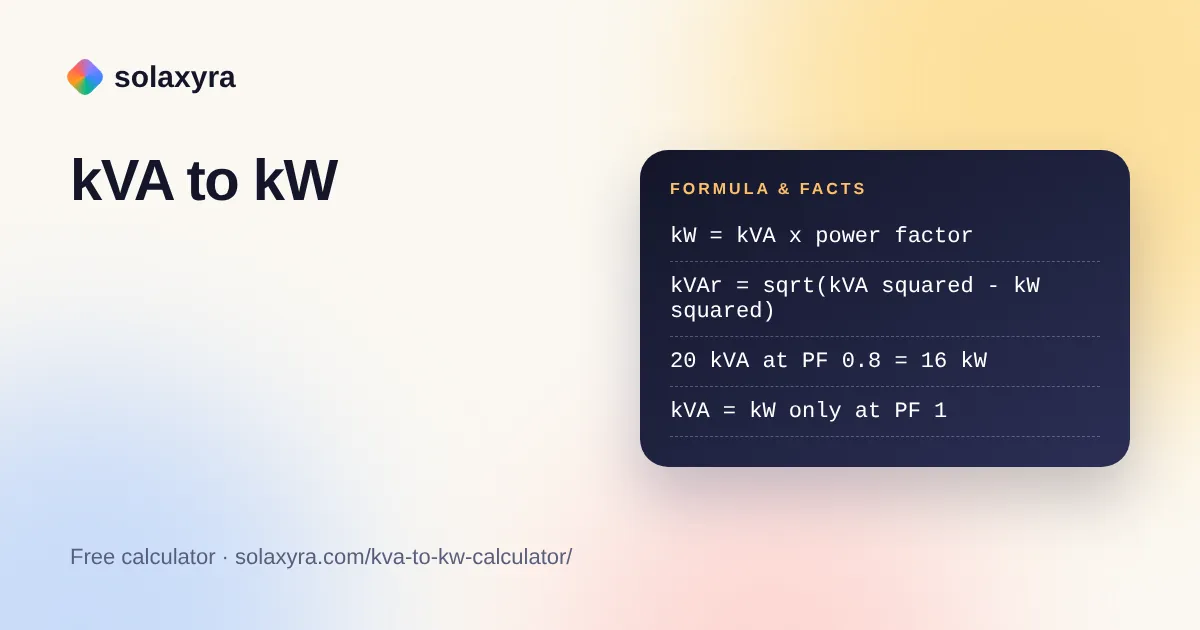
Quick answer: A kVA to kW calculator multiplies apparent power by the power factor: kW = kVA x PF. A 20 kVA generator at a power factor of 0.8 supplies 16 kW of real power; at a power factor of 1 it would supply 20 kW. kVA and kW are equal only for purely resistive loads such as heaters.
What Is a kVA to kW Calculator?
A kVA to kW calculator is a tool that converts apparent power, measured in kilovolt-amperes, into real power, measured in kilowatts, using the power factor of the load. In plain words, the real power is the apparent power multiplied by the power factor, a number between 0 and 1 that describes how much of the current actually does work.
The same formula works for single-phase and three-phase supplies, because both kVA and kW already include the phase arrangement. Voltage and phase only matter when you go one step further and work out current, which the calculator also does.
How Do You Use the kVA to kW Calculator?
- Enter the kVA rating from the generator, UPS, transformer or inverter plate.
- Choose a power factor preset or type your own. If the plate states a power factor, use that.
- Optionally enter the kW of the load you plan to connect, to see what share of the real power rating it uses.
- Pick the supply for the current figure: 400 V three-phase, 230 V single-phase, 120 V or 240 V.
- Read kW, kVAr, the phase angle and the full-load current, then open the breakdown to check the working.
How Many kW Is 1 kVA?
1 kVA equals 1 kW only at a power factor of 1; at 0.8 it is 0.8 kW, at 0.9 it is 0.9 kW and at 0.7 it is 0.7 kW. The table applies the same rule to common ratings.
| Rating (kVA) | PF 1.0 (kW) | PF 0.95 (kW) | PF 0.9 (kW) | PF 0.85 (kW) | PF 0.8 (kW) | PF 0.7 (kW) |
|---|---|---|---|---|---|---|
| 1 | 1 | 0.95 | 0.9 | 0.85 | 0.8 | 0.7 |
| 5 | 5 | 4.75 | 4.5 | 4.25 | 4 | 3.5 |
| 10 | 10 | 9.5 | 9 | 8.5 | 8 | 7 |
| 20 | 20 | 19 | 18 | 17 | 16 | 14 |
| 30 | 30 | 28.5 | 27 | 25.5 | 24 | 21 |
| 50 | 50 | 47.5 | 45 | 42.5 | 40 | 35 |
| 100 | 100 | 95 | 90 | 85 | 80 | 70 |
Read across a row to see how much real power you lose as the power factor falls. A 50 kVA supply feeding motors at 0.7 delivers 15 kW less useful power than the same supply feeding heaters.
Why Are Generators and UPS Units Rated in kVA?
Generators, transformers and UPS units are rated in kVA because their limit is the current their windings and electronics can carry, whatever the power factor of the load. As the volt-ampere reference explains, VA ratings are used for this equipment because loads may be reactive, and for a UPS the VA rating is set by maximum current while the watt rating is set by power handling.
That is why many UPS and generator plates show both figures, and why the lower of the two is the one that limits you. When a plate gives both kVA and kW, divide kW by kVA to find the power factor the manufacturer assumed, and use that in the calculator. When only kVA is shown, check the data sheet. Generator suppliers commonly work at 0.8: UK hire company Aggreko, for example, converts 375 kVA to 300 kW using a power factor of 0.8 in its own guidance. That is why 0.8 is the calculator's default, but the manufacturer's figure always wins.
What Power Factor Should You Use to Convert kVA to kW?
Use the power factor of the load you will connect, or the one stated by the equipment maker; use 1 for resistive heating and a lower value for motors, compressors and pumps. The power factor is the ratio of real to apparent power, and while heaters and filament lamps sit at almost 1, motors and transformers can be well below 1.
- Heaters, kettles, immersion elements, filament lamps: about 1.
- Motors, compressors, pumps, older fluorescent fittings: below 1; check the rating plate.
- Mixed site loads: combine the real and reactive parts of each load rather than averaging power factors, as in the worked example below.
To find a power factor from measured watts and volt-amperes, or to size correction capacitors, use the power factor calculator. To go the other way, from a kW load to the kVA rating you need, use the kW to kVA calculator.
What Is the Difference Between kVA, kW and kVAr?
kW is the real power that does work, kVAr is the reactive power that flows back and forth to build magnetic fields, and kVA is the combination of the two that the supply must carry; they form a right-angled triangle, so kVA squared equals kW squared plus kVAr squared. At a power factor of 0.8, a 20 kVA supply carries 16 kW of real power and 12 kVAr of reactive power.
The phase angle in the calculator is the angle between voltage and current, found from arccos of the power factor: 0 degrees at PF 1, about 36.9 degrees at PF 0.8. Your energy bill as a household counts kWh of real energy; reactive power still heats cables and uses up the capacity of generators and transformers, which is why it matters when you size equipment.
Worked Example: Hannah's Market Generator in Utrecht
Hannah organises a winter market in Utrecht and is quoted a 20 kVA, 400 V three-phase generator. Her stallholders list three groups of load:
- Patio and fan heaters: 6 kW at PF 1.
- A cold room and drinks fridges: 4 kW at PF 0.75 (from the compressor plates).
- LED festoon and stall lighting: 2 kW at PF 0.95 (from the drivers' data sheet).
- Real power: 6 + 4 + 2 = 12 kW.
- Reactive power: 0 + 4 x tan(arccos 0.75) + 2 x tan(arccos 0.95) = 0 + 3.53 + 0.66 = 4.19 kVAr.
- Apparent power: square root of (12 squared + 4.19 squared) = 12.7 kVA, an overall power factor of about 0.94.
- Generator capacity at the example PF of 0.8: 20 x 0.8 = 16 kW, so the 12 kW load uses 75% of the real power rating and 64% of the kVA rating.
- Current: 12.7 kVA x 1,000 / (1.732 x 400) = about 18.3 A per line if the load is spread evenly over the three phases.
The generator has headroom, but Hannah asks the hire company to confirm the kW rating and the starting capacity for the cold room compressor, and to connect the distribution through a competent electrician. Temporary supplies at events must be installed and tested by a competent person; in the UK the installation should meet BS 7671, and elsewhere the national wiring rules.
Frequently Asked Questions
How many kW is a 10 kVA generator?
A 10 kVA generator gives 8 kW at a power factor of 0.8, 9 kW at 0.9 and 10 kW only with purely resistive loads at a power factor of 1. Check the rating plate or data sheet, which often states the kW figure and the power factor assumed.
Is kVA bigger than kW?
For the same equipment, kVA is always equal to or larger than kW, because kW is kVA multiplied by a power factor of 1 or less. They are equal only for purely resistive loads such as heaters, kettles and filament lamps.
Does kVA to kW change between single-phase and three-phase?
No. kW = kVA x PF holds for both, because kVA and kW are already total figures. Phase and voltage only matter when you convert either value to current, where three-phase uses the 1.732 factor and line to line voltage.
Can I convert kVA to kW for a DC system?
kVA is an AC idea; on DC there is no reactive power, so watts and volt-amperes are the same and no conversion is needed. Battery inverters may still quote an AC output in VA, which you convert with the power factor of the AC load.
What happens if my load needs more kVA than the generator can supply?
The generator's voltage can sag, its protection may trip, or it may overheat, even if the kW total looks acceptable. Reduce the load, improve the power factor, or hire a larger set, and allow extra for motors that draw a surge when they start.
Why do UPS units show both VA and W?
A UPS has two separate limits: maximum current, expressed in VA, and maximum real power, expressed in W. Your connected load must stay under both. Add up the watts and the VA of your equipment separately and compare each with the matching rating.
Checked October 2026 by the Solaxyra Editorial Team. Sources: Wikipedia, Volt-ampere, Wikipedia, Power factor, Wikipedia, Three-phase electric power, Aggreko, What is the difference between kW and kVA.