Uses nominal voltage. Real energy varies slightly because battery voltage changes during discharge.
Formula and breakdown
n/a
n/a
This Ah to kWh calculator converts a battery’s amp-hour rating into kilowatt-hours of stored energy, or kilowatt-hours back into amp-hours, for leisure batteries, home storage, e-bikes and power stations. It also handles several identical batteries in series or parallel and shows the usable share, so owners in the UK, Ireland and Europe can compare batteries sold with different ratings on a like-for-like basis.
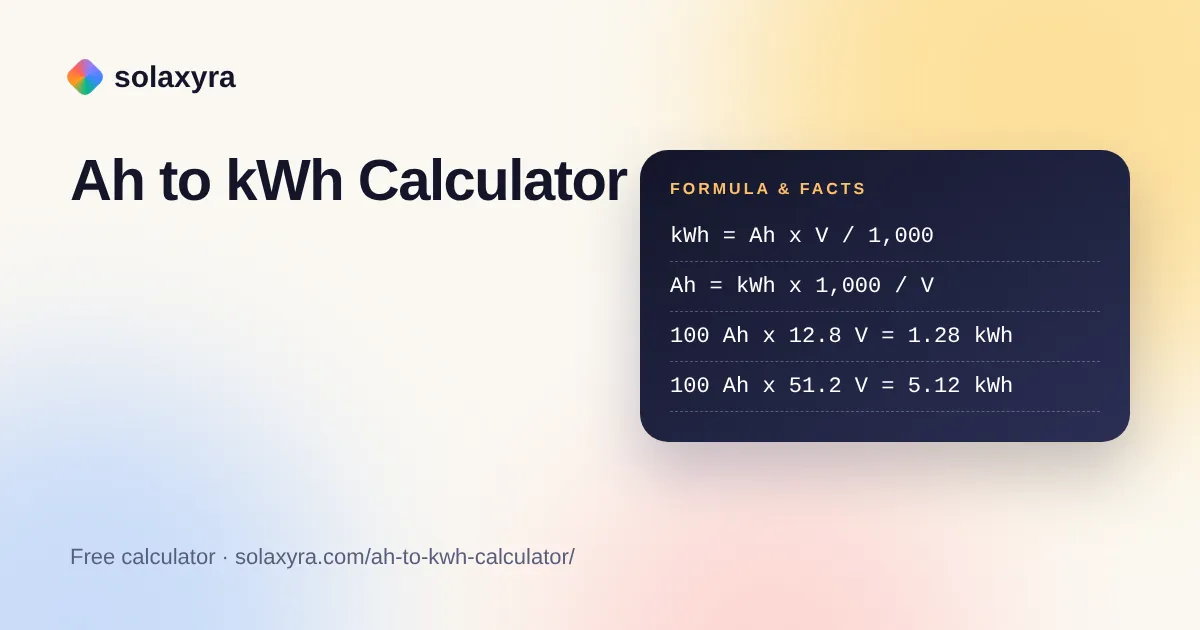
Quick answer: An Ah to kWh calculator multiplies amp-hours by nominal voltage and divides by 1,000. A 12.8 V 100 Ah battery holds 1.28 kWh, a 12 V 100 Ah battery holds 1.2 kWh and a 51.2 V 100 Ah battery holds 5.12 kWh. To go back, kWh times 1,000 divided by voltage gives amp-hours.
What Is an Ah to kWh Calculator?
An Ah to kWh calculator is a converter that turns battery charge capacity in amp-hours into energy in kilowatt-hours by multiplying by the battery’s voltage. In plain words: kilowatt-hours equal amp-hours times volts divided by 1,000, and amp-hours equal kilowatt-hours times 1,000 divided by volts.
Amp-hours and kilowatt-hours measure different things. An amp-hour is a unit of electric charge: one amp flowing for one hour, equal to 3,600 coulombs according to the ampere-hour definition. A kilowatt-hour is a unit of energy, the same unit used on your electricity bill. Charge only becomes energy once you know the voltage it is delivered at, which is why a 1.5 V cell and a 12 V battery with the same amp-hour rating store very different amounts of energy.
How Do You Use the Ah to kWh Calculator?
- Choose the direction: Ah to kWh, or kWh to Ah. The swap button converts your current value the other way.
- Enter the capacity in amp-hours, or the energy in kilowatt-hours.
- Enter the nominal voltage printed on the battery, or pick a common value from the presets.
- For a bank of identical batteries, enter how many there are and whether they are wired in parallel or series.
- Optionally enter the usable share (depth of discharge) to see how much of the energy you can actually use.
- Read the result and the breakdown, then copy it if you want to compare products.
How Many kWh Is a 100Ah Battery?
A 100 Ah battery holds 1.2 kWh at 12 V, 1.28 kWh at 12.8 V, 2.4 kWh at 24 V and 5.12 kWh at 51.2 V. The amp-hour figure alone tells you nothing about energy until you multiply by voltage. The table shows common capacities at the nominal voltages most often used for lead-acid and lithium iron phosphate batteries.
| Capacity | 12 V | 12.8 V | 24 V | 25.6 V | 48 V | 51.2 V |
|---|---|---|---|---|---|---|
| 7 Ah | 0.084 kWh | 0.090 kWh | 0.168 kWh | 0.179 kWh | 0.336 kWh | 0.358 kWh |
| 50 Ah | 0.60 kWh | 0.64 kWh | 1.20 kWh | 1.28 kWh | 2.40 kWh | 2.56 kWh |
| 100 Ah | 1.20 kWh | 1.28 kWh | 2.40 kWh | 2.56 kWh | 4.80 kWh | 5.12 kWh |
| 200 Ah | 2.40 kWh | 2.56 kWh | 4.80 kWh | 5.12 kWh | 9.60 kWh | 10.24 kWh |
| 280 Ah | 3.36 kWh | 3.58 kWh | 6.72 kWh | 7.17 kWh | 13.44 kWh | 14.34 kWh |
These are nominal figures. The Ah to kWh calculator lets you reduce them by the usable share your battery’s datasheet allows.
How Do You Convert kWh to Ah?
Multiply kilowatt-hours by 1,000 and divide by the battery or bank voltage: a 5 kWh battery at 51.2 V is about 97.7 Ah, and a 2 kWh battery at 12.8 V is 156.25 Ah. Use the voltage of the whole bank, not of a single cell, or the answer will be far too high. Home storage batteries are often described in kWh and leisure batteries in Ah, so this direction is useful when you need to match a home battery to a charge controller or inverter rated in amps. For phone power banks and small devices rated in milliamp-hours, the mAh to Wh calculator is a better fit.
Does Wiring Batteries in Series or Parallel Change the kWh?
No; total energy is the same either way, because it is always the number of batteries times each battery’s amp-hours times its voltage. Series wiring adds voltages and keeps the amp-hours of one battery, while parallel wiring adds amp-hours and keeps the voltage of one battery. Victron Energy’s battery bank wiring guide describes the same rule.
Enter four batteries in the Ah to kWh calculator and you will see it: four 12.8 V 100 Ah batteries give 5.12 kWh whether they form a 51.2 V 100 Ah bank in series or a 12.8 V 400 Ah bank in parallel. The choice affects current, cable size and inverter compatibility, not stored energy. To work out how many batteries you need in the first place, use the battery bank size calculator.
Why Is Usable kWh Lower Than the Label?
Usable energy is the nominal kWh multiplied by the share of capacity you can safely discharge, so a 1.28 kWh battery used to 90% gives about 1.15 kWh. Battery makers set a recommended depth of discharge to protect cycle life, and some state usable capacity separately from nominal capacity on the datasheet. When a datasheet lists both, compare products on usable kWh.
Voltage also changes during discharge. The conversion uses nominal voltage, which approximates the average; the ampere-hour reference notes that an average or nominal value may be used to approximate the true energy, which would require integrating voltage times current over the discharge. For runtime estimates that also include inverter losses, the battery runtime calculator goes a step further.
Worked Example: Niamh Compares Batteries in Galway
Niamh in Galway is choosing between a 12.8 V 200 Ah lithium iron phosphate battery for her camper and a portable power station rated at 2,048 Wh. She wants to know which stores more energy.
- Battery: 200 Ah x 12.8 V / 1,000 = 2.56 kWh nominal.
- Power station: 2,048 Wh / 1,000 = 2.048 kWh nominal.
- At a 90% usable share for both, the battery gives 2.30 kWh and the power station 1.84 kWh.
- Reverse check: 2.048 kWh at 12.8 V equals 160 Ah, so the power station is equivalent to a 160 Ah battery at that voltage.
The Ah to kWh calculator shows the battery stores about 25% more energy. Niamh also notes that the power station includes its own inverter and charger, so the comparison on energy is only part of the decision.
Is It Safe to Connect Batteries Into a Bank Yourself?
Not if it connects to a home’s wiring: any such battery must be installed or checked by a qualified electrician, in the UK a registered electrician working to BS 7671, and elsewhere in Europe under your national wiring rules. BSI’s PAS 63100:2024 also limits where home batteries may go, ruling out bedrooms, escape routes and lofts. Always fit correctly rated fuses close to the battery, use identical batteries in a bank and follow the manufacturer’s manual.
Frequently Asked Questions
What is the formula to convert Ah to kWh?
Multiply amp-hours by the nominal voltage to get watt-hours, then divide by 1,000 to get kilowatt-hours. For example, 100 Ah x 12.8 V = 1,280 Wh, which is 1.28 kWh. The voltage must be the battery or bank voltage, not the charger voltage.
Can I convert Ah to kWh without knowing the voltage?
No. Amp-hours measure charge, not energy, so the same amp-hour rating can mean very different energy at different voltages. Check the battery label or datasheet for the nominal voltage; if only a cell type is given, multiply the cell voltage by the number of cells in series.
How many Ah is a 5 kWh battery?
It depends on the voltage. A 5 kWh battery is about 97.7 Ah at 51.2 V, about 104 Ah at 48 V and about 391 Ah at 12.8 V. Divide 5,000 Wh by the bank voltage to get the amp-hours.
Why does a 12.8 V battery show more kWh than a 12 V one?
Energy equals amp-hours times voltage, so a higher nominal voltage gives more energy for the same amp-hours. A 100 Ah battery at 12.8 V holds 1.28 kWh, while a 100 Ah battery at 12 V holds 1.2 kWh, about 6% less.
Do two batteries in series double the amp-hours?
No. In series the voltage doubles and the amp-hours stay the same as one battery. In parallel the amp-hours double and the voltage stays the same. The total kilowatt-hours double in both cases, as the calculator shows when you enter two batteries.
Is kWh or Ah better for comparing batteries?
Kilowatt-hours, or watt-hours, are better because they include voltage and measure energy directly. Amp-hours are only comparable between batteries of the same voltage. For the fairest comparison, use usable kWh after the recommended depth of discharge.
Checked October 2026 by the Solaxyra Editorial Team. Sources: Wikipedia: Ampere-hour, Victron Energy: Wiring Unlimited, battery bank wiring, Wikipedia: Depth of discharge, BSI PAS 63100:2024 overview.