Estimate based on average days. Real savings depend on your tariff rules, usage pattern, weather and how the battery is controlled.
Formula and breakdown
n/a
n/a
n/a
n/a
This home battery savings calculator estimates how much a household battery could cut your electricity bill each year by storing surplus solar and by charging at cheap off-peak times, then shows the payback period. It is set up for the UK with the current price cap rate as the default, and works in pounds or euros for Ireland and the rest of Europe.
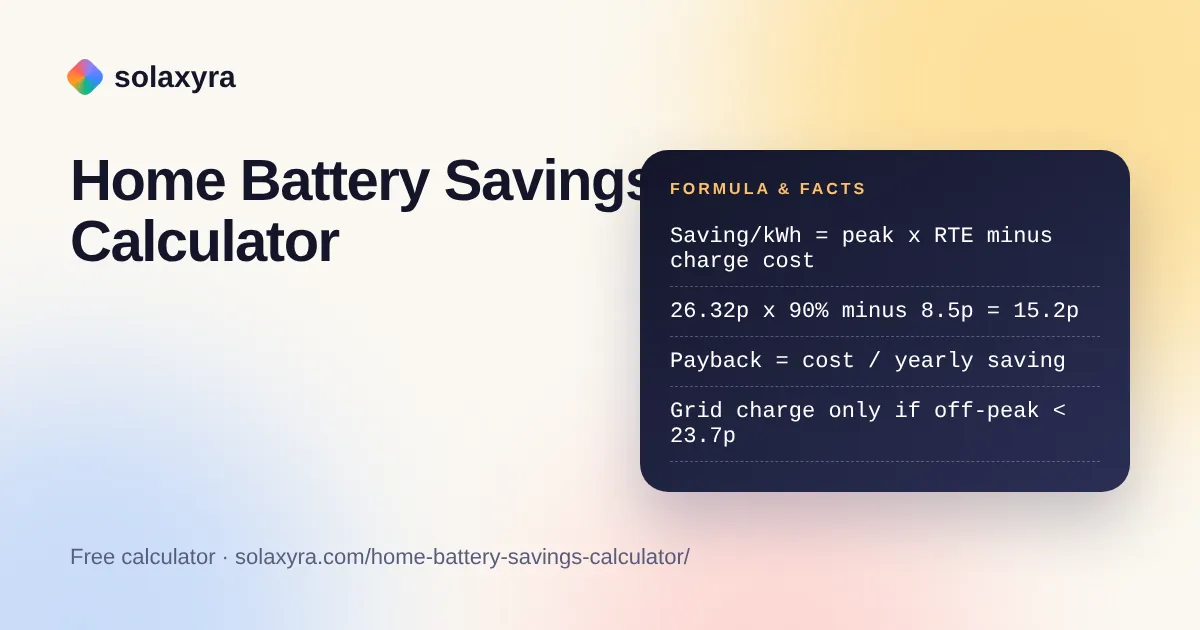
Quick answer: A home battery savings calculator values each stored kWh at your peak price times round-trip efficiency, minus what that kWh cost to charge: lost export for solar, or the off-peak price for grid charging. At 26.32p peak, 8.5p off-peak and 90% efficiency, each kWh charged overnight saves about 15.2p.
What Is a Home Battery Savings Calculator?
A home battery savings calculator is a tool that estimates the yearly money a household battery saves by moving electricity from cheap or free times to expensive times, and how many years it takes to repay its installed cost. In plain words: yearly saving equals energy delivered by the battery times the price you avoid, minus what it cost to fill the battery.
The calculator models two kinds of day. On sunny days it stores solar surplus up to the battery’s usable capacity, limited by how much you use in the evening, and then tops up from the grid off-peak if there is room. On other days it fills from the grid off-peak, but only if that is worth doing after losses. Yearly savings are then reduced each year by capacity loss and adjusted by any price change you enter, to give a payback year and a ten-year net position.
How Do You Use the Home Battery Savings Calculator?
- Say whether you have solar panels and whether you will charge from the grid at off-peak times.
- Enter the usable capacity of the battery and its round-trip efficiency from the datasheets.
- Enter how many kWh a day you use at peak or standard-rate times that the battery could cover, typically evenings.
- Enter your standard or peak unit price and, if relevant, your off-peak price. Prices are in pence or cents per kWh.
- With solar, enter the typical surplus on a sunny day, how many such days you get a year and your export rate.
- Enter the installed price from your quote, an annual capacity loss and an optional yearly price change.
- Read the year one saving, payback period and ten-year position, then open the breakdown to check each step.
How Much Can a Home Battery Save Per Year?
Each kWh a battery shifts saves roughly your peak price times its efficiency, minus the cost of charging it, so the yearly saving is that margin times the kWh shifted. With the UK price cap rate of 26.32p per kWh set by Ofgem for October to December 2026, a 90% efficient battery displaces about 23.7p of imports for every kWh put in.
| Cost of charging 1 kWh | Saving per kWh charged | Yearly saving at 9 kWh charged per day |
|---|---|---|
| Solar, export rate 0p | 23.7p | £778 |
| Solar, export rate 4p (example) | 19.7p | £647 |
| Off-peak 5p (example) | 18.7p | £614 |
| Off-peak 8.5p (example) | 15.2p | £499 |
| Off-peak 15p (example) | 8.7p | £285 |
| Off-peak 20p (example) | 3.7p | £121 |
Assumes a peak price of 26.32p, 90% round-trip efficiency, 9 kWh charged and 8.1 kWh used every day of the year, and no capacity loss. Export and off-peak prices are illustrative; enter your own in the home battery savings calculator.
Is a Home Battery Worth It Without Solar Panels?
A battery without solar only saves money if your off-peak price is below your peak price times the battery’s round-trip efficiency; at 26.32p and 90% efficiency, that break-even is about 23.7p per kWh. The wider the gap, the larger the saving. A time-of-use or overnight tariff is therefore essential, and the home battery savings calculator switches off grid charging automatically when it would lose money.
Because savings depend on the spread between two prices, check your tariff’s rules: the hours of the cheap window, whether the rate applies to the whole home and any standing charge difference. If you are also considering panels, the solar panel savings calculator shows what the panels earn on their own.
Does Storing Solar Beat Exporting It?
Storing solar is worth more than exporting it whenever your export rate is lower than your import price times the battery’s efficiency. With an export rate of 4p and an import price of 26.32p, each stored kWh is worth about 19.7p more than selling it. If you are paid for exports, for example under a Smart Export Guarantee tariff in Great Britain, you can estimate that income with the Smart Export Guarantee calculator.
The solar benefit is seasonal. In northern Europe winter surpluses are small, so the calculator asks how many days a year you have a meaningful surplus. On the remaining days, off-peak charging can keep the battery working.
How Long Does a Home Battery Take to Pay Back?
Simple payback is installed cost divided by the yearly saving, so a £4,500 battery saving £540 a year pays back in about 8.3 years before any capacity loss. The calculator goes further by reducing each year’s saving by the capacity loss you enter (2% a year by default, as an example) and applying any yearly price change, which in the default case moves payback to about 9 years.
Compare the payback period with the battery’s warranty, which may limit years, cycles or total energy throughput. If the calculated payback is longer than the warranty, the investment is uncertain. The equivalent full cycles figure helps you check the throughput limit.
Is It Safe to Install a Home Battery?
A home battery is safe when it is installed by a competent, qualified installer in a suitable location; in the UK the connection must be done or checked by a registered electrician working to BS 7671. BSI’s PAS 63100:2024 sets fire safety requirements for domestic battery storage, including keeping it out of bedrooms, escape routes, lofts and roof spaces, and at least 2 m from stored flammable materials. Elsewhere in Europe, follow national wiring rules and the manufacturer’s installation manual.
Worked Example: Sarah’s Battery in Leeds
Sarah in Leeds has solar panels and is quoted £3,800 for a battery with 5 kWh usable capacity and 90% round-trip efficiency. She uses about 6 kWh each evening, pays 26.32p per kWh at peak, has an example off-peak rate of 8.5p and an export rate of 4p. She expects a 5 kWh surplus on about 160 days a year.
- Sunny days: she stores 5 kWh, gets back 4.5 kWh, and saves 4.5 x 26.32p minus 5 x 4p = 98.4p a day. Over 160 days that is £157.50.
- Other days: she charges 5 kWh off-peak and gets 4.5 kWh back, saving 4.5 x 26.32p minus 5 x 8.5p = 75.9p a day. Over 205 days that is £155.68.
- Year one saving: about £313.
- With 2% capacity loss a year, the home battery savings calculator puts payback at about 13.8 years, and the ten-year position at about £936 short of the cost.
Sarah’s battery cycles once a day, so a larger battery would add little unless her evening use grows. To check whether a different size suits her better, she can use the solar battery size calculator.
Frequently Asked Questions
How is home battery saving calculated?
For every kWh the battery delivers, you avoid buying a kWh at your peak price. Subtract what it cost to charge the battery, which is lost export income for solar or the off-peak price for grid charging, adjusted for round-trip efficiency. Multiply by the kWh shifted each year.
What round-trip efficiency should I use?
Use the figure on your battery or hybrid inverter datasheet, ideally for the full system from AC in to AC out. The calculator’s 90% default is an example. Efficiency also varies with charge and discharge rate, so a slightly lower figure gives a more cautious estimate.
Why is my off-peak saving shown as not worth it?
Charging from the grid only pays when the off-peak price is lower than the peak price times efficiency. At 26.32p and 90% efficiency the limit is about 23.7p. If your cheap rate is above that, losses in the battery cancel out the price difference.
Does battery size change the savings?
Only up to a point. Savings are limited by the smallest of usable capacity, daily solar surplus and the energy you use at peak times. A battery larger than your evening use cannot discharge fully each day, so extra capacity adds cost without adding much saving.
Do home batteries lose capacity over time?
Yes. Usable capacity falls gradually with age and use, and deeper regular cycling tends to shorten cycle life. Check the warranty for the guaranteed remaining capacity, then enter a yearly capacity loss in the calculator to see how it lengthens payback.
Can I use this calculator outside the UK?
Yes. Switch the currency to euros and enter your local peak, off-peak and export prices in cents per kWh. Adjust the number of sunny surplus days for your location, as solar surplus in southern Europe is usually available on more days than in Ireland or Scotland.
Checked October 2026 by the Solaxyra Editorial Team. Sources: Ofgem: Energy price cap 1 October to 31 December 2026, BSI PAS 63100:2024 overview, Wikipedia: Lithium-ion battery, Wikipedia: Depth of discharge.