Estimate only. Real runtime also depends on temperature, battery age and how the load cycles.
Formula and breakdown
n/a
n/a
n/a
n/a
This battery runtime calculator estimates how many hours a 12 V, 24 V, 48 V or home storage battery can power a given load, for campers, boat owners, off-grid cabins and households in the UK, Ireland and the rest of Europe. Enter the capacity in amp-hours or watt-hours, the load in watts, the usable depth of discharge and, for AC appliances, the inverter efficiency and standby draw.
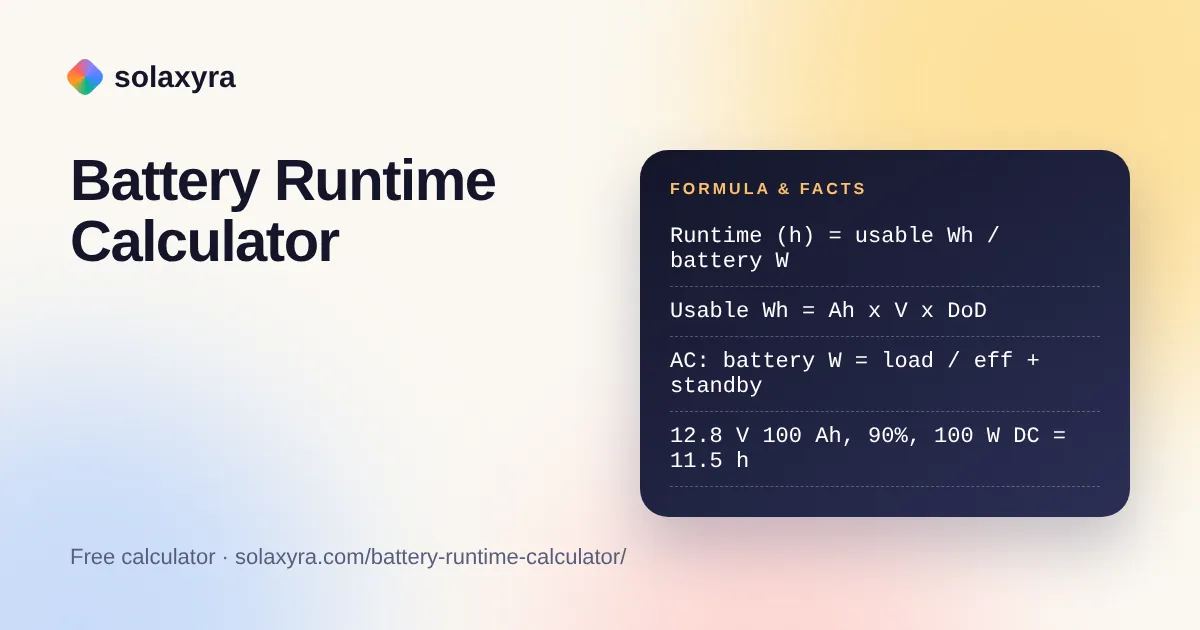
Quick answer: A battery runtime calculator divides usable energy by the power drawn from the battery. Usable energy is amp-hours times voltage times depth of discharge. For AC appliances, divide the load by inverter efficiency and add the inverter’s standby watts. A 12.8 V 100 Ah lithium battery at 90% usable runs a 100 W DC load for about 11.5 hours.
What Is a Battery Runtime Calculator?
A battery runtime calculator is a tool that converts a battery’s stored energy and an appliance’s power draw into the number of hours the battery can keep that appliance running. In plain words: runtime in hours equals usable watt-hours divided by the watts the battery actually supplies.
The calculator works in four steps. First it finds nominal energy: amp-hours multiplied by nominal voltage gives watt-hours. One amp-hour is the charge moved by one amp for one hour, which is 3,600 coulombs, as the ampere-hour definition explains; multiplying by an average or nominal voltage turns that charge into energy. Second, it keeps only the share you plan to use (depth of discharge) and reduces it further for an ageing battery. Third, it works out battery-side power, which is higher than the appliance rating when an inverter sits in between. Finally it divides energy by power, and for lead-acid batteries it can apply a Peukert correction.
How Do You Use the Battery Runtime Calculator?
- Choose whether you know the capacity in amp-hours (Ah) or watt-hours (Wh), then type it in.
- Enter the nominal battery voltage. Lithium iron phosphate batteries sold as “12 V” usually state 12.8 V on the label.
- Add up the watts of everything that will run at the same time and enter the total as the load.
- Pick the battery type. This fills in example values for usable depth of discharge and the Peukert exponent; replace them with your datasheet figures.
- Select AC via inverter for mains appliances, or DC direct for 12 V fridges, lights and USB chargers.
- For AC, enter the inverter efficiency and its standby (zero-load) power from the inverter datasheet.
- Read the runtime and open “Formula and breakdown” to check each step.
How Long Will a 100Ah Battery Last?
A 12.8 V 100 Ah lithium battery used to 90% supplies about 1,152 Wh, so it lasts roughly 11.5 hours at 100 W on DC and about 9 hours 40 minutes at 100 W through an inverter. The table assumes a 90% efficient inverter with 8 W of standby draw, which is close to a published small inverter specification.
| Load (W) | DC direct runtime | AC via inverter runtime | Typical example |
|---|---|---|---|
| 20 | 57 h 36 min | 38 h 7 min | LED lights and phone charging |
| 50 | 23 h 2 min | 18 h 8 min | Compressor cool box (average) |
| 100 | 11 h 31 min | 9 h 40 min | Laptop and router |
| 300 | 3 h 50 min | 3 h 22 min | TV, laptop and lights |
| 500 | 2 h 18 min | 2 h 3 min | Blender or small power tool |
| 1,000 | 1 h 9 min | 1 h 2 min | Microwave on a low setting |
Values come from the battery runtime calculator above for a 12.8 V 100 Ah battery, 90% usable, 100% health, no Peukert correction. Appliance examples are illustrative; check the rating plate of your own device.
How Much Does an Inverter Reduce Battery Runtime?
An inverter typically cuts runtime by around 10% at medium loads and by much more at very light loads, because it has conversion losses plus a fixed standby draw. Victron Energy’s Phoenix inverter datasheet lists a maximum efficiency of 92% and a zero-load power of 7.9 W for its 12 V 1200 VA model. That is a best case, so a slightly lower value is sensible.
The standby draw matters most overnight. Select AC in the battery runtime calculator to see the effect: if an inverter is left on to run a 20 W router, the 8 W it uses itself is 40% of the load. Running small loads on DC, or switching the inverter off when nothing needs mains power, is the easiest way to gain hours. If you need to know the current in the cables for a given wattage, the watts to amps calculator shows it for DC and AC.
What Depth of Discharge Should You Use?
Use the usable capacity or recommended depth of discharge printed on your battery’s datasheet; many lithium iron phosphate products allow most of their rated capacity, while lead-acid batteries are usually planned around a much smaller share to protect their life. The calculator’s defaults (90% for LiFePO4, 50% for lead-acid) are editable examples, not manufacturer claims.
Depth of discharge is the share of capacity removed from a full battery. For almost all rechargeable chemistries, deeper regular cycling shortens cycle life, which is why some lithium iron phosphate systems are deliberately limited to a 15% to 85% state of charge window, a 70% depth of discharge. If you are choosing a new battery rather than checking an existing one, the battery bank size calculator works backwards from your daily use to the amp-hours you need.
Why Does a Lead-Acid Battery Run Out Sooner at High Loads?
A lead-acid battery delivers less than its rated amp-hours when discharged faster than its rating period, an effect described by Peukert’s law. Capacity is commonly rated over 20 hours (C20), so a 100 Ah battery is tested at about 5 A. Draw 50 A and the usable charge falls noticeably.
The formula used here is t = H x (C / (I x H))^k, where H is the rated hours, C the rated amp-hours, I the actual current and k the Peukert exponent. Reported exponents are about 1.05 to 1.15 for AGM, 1.1 to 1.25 for gel and 1.2 to 1.6 for flooded batteries. Lithium batteries behave close to 1.00, so leave the correction off for them in the battery runtime calculator. At loads lighter than the rating, the formula would credit extra capacity; this calculator ignores that bonus and keeps the simpler, more cautious figure.
Is It Safe to Run a Home Battery Until It Is Flat?
No; let the battery management system (BMS) or inverter low-voltage cut-off stop the discharge, and never bypass it to gain extra minutes. Lithium cells also must not be charged below freezing unless the product is designed for it, because many types can plate lithium on the anode at temperatures under 0 °C.
Fixed home batteries connected to your wiring must be installed or checked by a qualified electrician. In the UK that means a registered electrician working to BS 7671, and BSI’s PAS 63100:2024 sets fire safety rules for domestic battery storage, including not placing it in bedrooms, escape routes, lofts or roof spaces. Elsewhere in Europe, follow your national wiring rules.
Worked Example: Tom’s Weekend Cabin in County Cork
Tom has a 12.8 V 100 Ah LiFePO4 battery in a small cabin near Cork and uses the battery runtime calculator to plan his evenings. In the evening he runs a TV, a laptop and LED lights totalling 300 W through a pure sine inverter rated at 90% efficiency with 8 W standby draw.
- Nominal energy: 100 Ah x 12.8 V = 1,280 Wh.
- Usable energy at 90% depth of discharge and full health: 1,280 x 0.90 = 1,152 Wh.
- Battery-side power: 300 W / 0.90 + 8 W = 341.3 W.
- Runtime: 1,152 / 341.3 = 3.38 hours, or about 3 h 23 min.
Tom’s neighbour Aoife uses a 12 V 100 Ah AGM battery to run a 100 W DC load. At 50% usable the simple answer is 600 Wh / 100 W = 6 hours. Her current is 8.3 A, above the 5 A rating current, so with a Peukert exponent of 1.10 the estimate drops to about 5 h 42 min. To see what the same battery is worth in kilowatt-hours, try the Ah to kWh calculator.
Frequently Asked Questions
How do I calculate battery runtime from amp-hours?
Multiply amp-hours by the battery voltage to get watt-hours, multiply by the usable share, then divide by the load in watts. For example, 100 Ah x 12.8 V x 0.9 = 1,152 Wh, and 1,152 Wh divided by 100 W gives about 11.5 hours on a DC load.
Why is my real runtime shorter than the calculator result?
Common reasons are a load that is higher than its label suggests, an inverter running below its best efficiency, cold temperatures, an older battery with reduced capacity, and high current on lead-acid batteries. Lower the battery health and inverter efficiency inputs to match your conditions.
Do I need the Peukert exponent for a lithium battery?
Usually not. The Peukert effect is a lead-acid characteristic, and lithium iron phosphate batteries deliver close to their rated capacity across normal currents. Leave the exponent at 1.00 for lithium and use the manufacturer’s maximum continuous current rating as your limit instead.
What is the C-rate shown in the results?
The C-rate is battery current divided by rated amp-hours. A 100 Ah battery supplying 50 A is discharging at 0.5C. Above 1C most batteries are working hard, so check the continuous discharge limit in the datasheet and the rating of the battery management system.
Does inverter standby power matter for battery runtime?
Yes, especially at light loads or overnight. An inverter drawing 8 W while powering a 20 W device uses 40% as much energy as the device itself. Switch the inverter off when idle or run small loads on DC to gain several hours.
Can I use this calculator for a portable power station?
Yes. Choose watt-hours, enter the rated Wh and the internal battery voltage if listed, then set inverter efficiency for AC outlets or select DC for USB and 12 V sockets. Usable capacity is often lower than the rated figure, so check the manual.
Checked October 2026 by the Solaxyra Editorial Team. Sources: Wikipedia: Peukert’s law, Wikipedia: Ampere-hour, Wikipedia: Depth of discharge, Victron Energy Phoenix inverter datasheet, BSI PAS 63100:2024 overview, Wikipedia: Lithium-ion battery.