A yearly energy balance, not an hourly simulation. Real results vary with weather, season and daily habits.
Formula and breakdown
Self-consumption = (solar used directly + solar sent to battery) / solar generated. Self-sufficiency = (solar used directly + energy delivered by battery) / household use.
Estimate mode: direct use = the smaller of generation and (use x daytime share). Battery charge = the smallest of surplus, usable capacity x cycles, and remaining night use / efficiency. Battery delivers charge x efficiency.
Meter mode: solar used on site = generation − export; household use = solar used on site + import.
n/a
This solar self consumption calculator estimates how much of the electricity from your solar panels you use at home, and how much of your total demand solar covers, for homes in the UK, Ireland and the rest of Europe. It works from simple yearly estimates or from smart meter readings, and shows what adding a home battery changes.
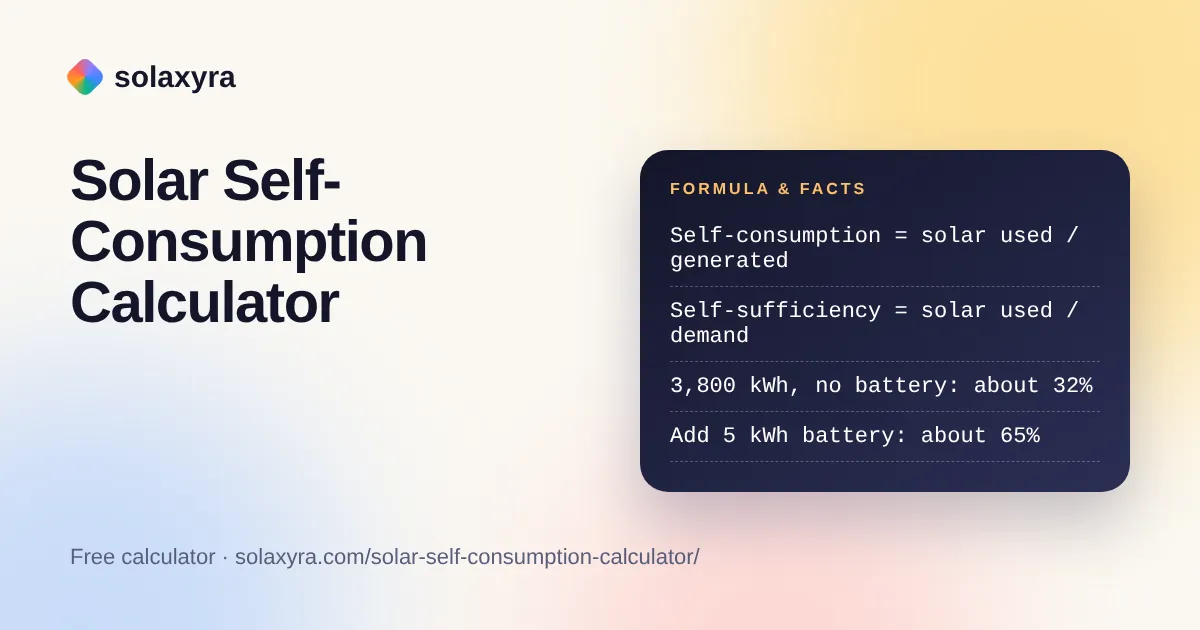
Quick answer: A solar self consumption calculator divides the solar energy you use on site, including energy stored in a battery, by total generation. Self-sufficiency divides the solar energy you actually use by your total consumption. A home generating 3,800 kWh and using 3,500 kWh, 35% in daylight, reaches about 32% self-consumption without a battery and 65% with 5 kWh.
What Is a Solar Self Consumption Calculator?
A solar self consumption calculator is a tool that splits your yearly solar generation into the part you use yourself and the part you export, and reports two percentages: the self-consumption rate and the degree of self-sufficiency. The definitions follow those used by the Solar Storage Systems research group at HTW Berlin in its independence calculator: self-consumption is the share of generated solar electricity that is used at the same time or used to charge a battery, and self-sufficiency is the share of consumption covered by solar, either directly or from the battery.
In plain words, the formulas are:
- Self-consumption rate = (solar used directly + solar charged into the battery) / total solar generated x 100.
- Self-sufficiency = (solar used directly + energy delivered by the battery) / total household use x 100.
- Without a battery, solar used on site = generation − export.
How Do You Use the Solar Self Consumption Calculator?
- Choose “Estimate my rates” if you are planning a system, or “Use meter readings” if you already have a year of generation, export and import data.
- Enter yearly solar generation from your quote or inverter app.
- In estimate mode, enter yearly household use and the share of it that happens while the panels are generating. Daytime cooking, laundry, home working and electric car charging all raise this share.
- Add a battery if you have or are considering one: usable capacity, full cycles per year and round-trip efficiency. Enter 0 kWh for no battery.
- Check the import price and export rate so the calculator can value the result.
- Read both percentages, the energy flows in kWh and the yearly value. Open the breakdown to see every step.
How Do You Calculate Solar Self-Consumption?
Subtract the electricity you exported from the electricity you generated, then divide by generation: a system producing 3,800 kWh and exporting 1,700 kWh has a self-consumption rate of 2,100 / 3,800 = 55%. Most inverter apps show generation, and a smart meter records export and import separately, so meter mode in this calculator needs only three numbers.
If you do not have readings yet, the estimate mode builds a yearly energy balance. Direct use is the smaller of your generation and your daytime demand. Any surplus can charge a battery, limited by its usable capacity multiplied by how many full cycles it completes in a year, and by how much evening demand there is to serve. The battery returns that charge minus its round-trip losses. What remains is exported. This is a yearly balance rather than an hourly simulation, so treat the answer as a planning estimate. The HTW Berlin group notes that even its detailed simulation can differ by more than 10% from real results depending on location and behaviour.
What Is the Difference Between Self-Consumption and Self-Sufficiency?
Self-consumption measures how well your solar output is used, while self-sufficiency measures how independent your home is from the grid. They move in opposite directions as a system grows. Adding panels raises generation but not your daytime demand, so self-consumption falls while self-sufficiency stays about the same or rises. Adding a battery raises both, because evening use can then be met from stored daytime surplus. For savings, both matter: self-consumption tells you how much of each kWh you are getting full value from, and self-sufficiency tells you how much of your bill disappears.
How Much Does a Battery Increase Self-Consumption?
In this calculator’s model, a battery that fills on most days can roughly double self-consumption for a home with little daytime demand. With this calculator’s defaults, adding a 5 kWh battery completing 250 full cycles a year at 90% efficiency raises self-consumption from about 32% to 65%, and self-sufficiency from 35% to 67%. The table below, produced with this solar self consumption calculator for a home using 3,500 kWh a year with 35% of it in daylight, shows how the result depends on system size.
| Yearly generation | Self-consumption, no battery | Self-sufficiency, no battery | Self-consumption, 5 kWh battery | Self-sufficiency, 5 kWh battery |
|---|---|---|---|---|
| 1,750 kWh | 70% | 35% | 100% | 49% |
| 3,500 kWh | 35% | 35% | 71% | 67% |
| 5,250 kWh | 23% | 35% | 47% | 67% |
| 7,000 kWh | 18% | 35% | 35% | 67% |
Two patterns stand out. A small system can reach 100% self-consumption with a battery but covers less than half of the home’s demand. Large systems export most of their output unless the battery is very large, and a big battery only helps if it actually fills on most days, which is far less likely in winter. To size one around your evening use, try the solar battery size calculator.
Why Does Self-Consumption Matter for Savings?
Self-consumption matters because a kWh you use is worth your full import price, while a kWh you export earns only your export rate. Under the Ofgem price cap from 1 October to 31 December 2026, the direct debit electricity unit rate is 26.32p per kWh. The Energy Saving Trust says that typically you will get around 12p for each exported unit, and that you would normally buy electricity for more than twice that amount. Moving 1,000 kWh a year from export to self-use is therefore worth roughly £143 a year at those prices. To see what your remaining export earns, use the Smart Export Guarantee calculator.
Worked Example: Hannah’s Home in York
Hannah in York expects her new panels to generate 4,200 kWh a year. Her household uses 4,000 kWh, and because she works from home, she estimates 40% of that use happens while the panels are generating. She enters these figures in the solar self consumption calculator.
- Without a battery: direct use is the smaller of 4,200 kWh and 4,000 x 40% = 1,600 kWh. Self-consumption is 1,600 / 4,200 = 38% and self-sufficiency is 1,600 / 4,000 = 40%. She exports 2,600 kWh and imports 2,400 kWh.
- With an 8 kWh battery, 220 full cycles a year and 90% round-trip efficiency: the battery stores 8 x 220 = 1,760 kWh and returns 1,584 kWh. Self-consumption rises to 80% and self-sufficiency to 80%. Export falls to 840 kWh and import to 816 kWh.
- At 26.32p import and a 12p example export rate, the yearly value of her solar rises from about £733 to about £939, an increase of about £206 a year.
Hannah can now compare that £206 with the quoted battery price to judge whether storage is worth it for her.
Frequently Asked Questions
What is a good solar self-consumption rate?
There is no single target, because the rate falls as the system gets bigger relative to your use. Aim to use as much as practical, since each self-used kWh saves your import price, 26.32p under the October 2026 Ofgem cap, while export earns less.
What is the difference between self-consumption and self-sufficiency?
Self-consumption is the share of your solar generation that you use, including energy charged into a battery. Self-sufficiency is the share of your total electricity use that solar covers. A large array can have low self-consumption but high self-sufficiency.
How do I calculate self-consumption from my smart meter?
Subtract a year of exported kWh from a year of generated kWh, then divide by generation. For self-sufficiency, divide that same on-site solar figure by on-site solar plus imported kWh. Choose meter mode in the calculator to do this automatically.
How much does a battery increase self-consumption?
It depends on battery size, how often it fills and your evening use. In our default example, adding a 5 kWh battery raises self-consumption from about 32% to 65%. A battery that rarely fills, or a home with little evening use, gains less.
Why does a bigger solar system lower my self-consumption rate?
Your daytime demand stays the same while generation grows, so a larger share has nowhere to go but the grid. Self-sufficiency still rises slightly or holds steady, and total savings can still increase, but each extra kWh is worth only the export rate.
How can I use more of my own solar power?
Run washing machines, dishwashers and dryers in daylight, heat hot water with a solar diverter, charge an electric car at midday and use timers. A battery stores surplus for the evening. Each change raises both self-consumption and self-sufficiency.
Checked October 2026 by the Solaxyra Editorial Team. Sources: HTW Berlin Solar Storage Systems group: Independence Calculator, Energy Saving Trust: Solar panels, Ofgem: Energy price cap October to December 2026.