Estimate only, not financial advice. Real results depend on your tariff, usage and system performance.
Formula and breakdown
Generation in year n = first-year kWh x (1 − output loss)^(n − 1).
Benefit in year n = kWh x self-use share x import price x (1 + import change)^(n − 1) + kWh x export share x export rate x (1 + export change)^(n − 1), minus maintenance and any inverter cost that year.
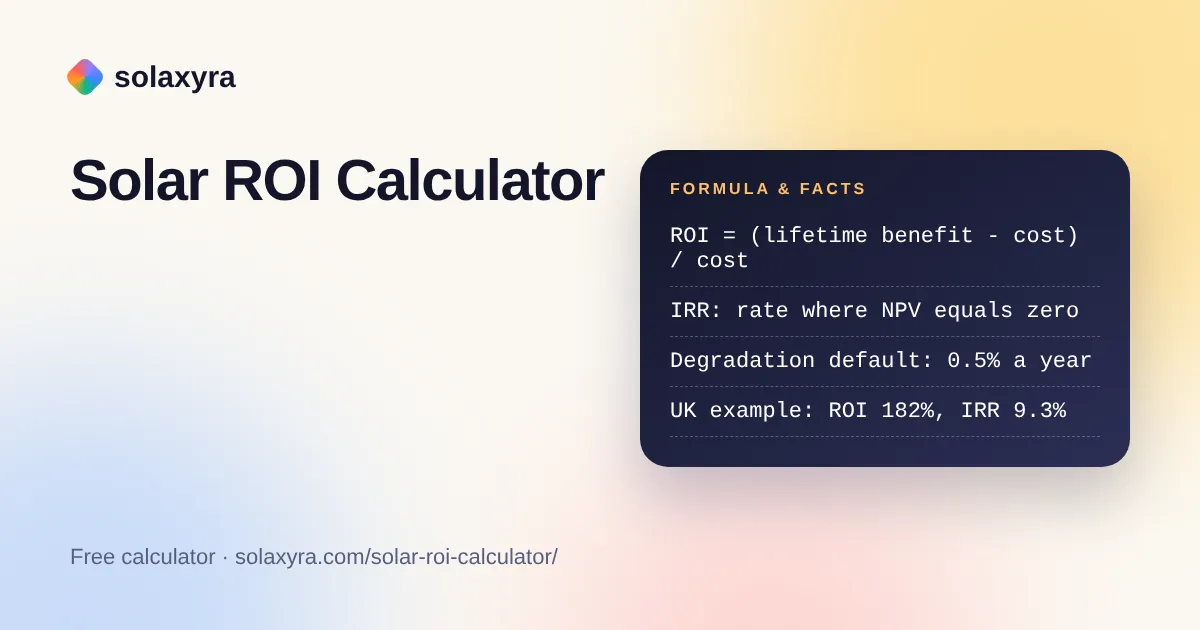
ROI = (sum of yearly benefits − installed cost) / installed cost x 100. IRR is the discount rate at which NPV equals zero, found by bisection. NPV = sum of benefit / (1 + discount rate)^n − installed cost.
n/a
This solar ROI calculator builds a year-by-year cash flow for a home solar system and shows UK and European households the lifetime return on investment, internal rate of return (IRR), net present value (NPV) and payback year. It separates electricity used at home from electricity exported, so each is valued at the right price.
Quick answer: A solar ROI calculator adds up every year’s bill savings and export income over the system life, subtracts the installed cost and running costs, then divides by the installed cost. With UK defaults of £7,600, 3,800 kWh, 50% self-use, 26.32p import and a 12p example export rate, 25-year ROI is about 182% and IRR about 9.3%.
What Is a Solar ROI Calculator?
A solar ROI calculator is a tool that measures how much profit a solar panel system returns over its life compared with what it cost to install. In plain words: work out each year’s generation, value the share you use at your import price and the share you export at your export rate, take off maintenance and any inverter replacement, add the years together, subtract the installed cost, and divide the result by the installed cost.
ROI on its own does not say how quickly the profit arrives, so this solar ROI calculator also reports IRR, the yearly interest rate the investment is equivalent to, and NPV, the profit expressed in today’s money after discounting future years. Together with the payback year, those four numbers let you compare solar fairly with paying off a mortgage, saving or investing elsewhere.
How Do You Use the Solar ROI Calculator?
- Pick your currency. Prices per kWh are entered in pence or cents.
- Enter the installed cost after any grant, and the first-year generation from your quote. If you have no estimate, the solar panel output calculator gives one from system size and location.
- Enter the share of solar you expect to use at home. The rest is treated as export.
- Check the import price (UK default: the Ofgem cap rate) and type in your own export rate.
- Set yearly changes for import and export prices, and keep panel output loss at 0.5% unless your warranty says otherwise.
- Add maintenance, inverter replacement, a discount rate and the number of years to model.
- Read ROI, net profit, IRR, NPV and payback, then open the breakdown for the cash-flow table.
How Do You Calculate the ROI of Solar Panels?
Solar ROI equals lifetime net benefit divided by installed cost, multiplied by 100. Lifetime net benefit is the sum of every year’s bill savings and export income, minus maintenance and replacement parts, minus the original cost. The year-by-year part matters because three things change over time:
- Output falls slowly. An NREL review of PV degradation covering more than 2,000 measured rates found a median loss of 0.5% a year.
- Prices change. Your import price and export rate may rise or fall at different speeds, so this calculator lets you set them separately.
- Parts wear out. The Energy Saving Trust says panels should last 25 years or more, but the inverter usually needs replacing after around 12 years.
What Is a Good Return on Investment for Solar Panels?
A good solar return is an IRR clearly above the interest you could earn or the interest you pay on debt. With the UK defaults on this page, IRR is about 9.3% a year, which you can compare directly with a savings rate or a loan rate. ROI over 25 years looks larger, about 182%, because it is a total for the whole period rather than a yearly rate. Never compare a 25-year ROI with a one-year savings rate; compare IRR with the yearly rate instead.
Which Inputs Change Solar ROI the Most?
Self-consumption, installed cost and the import price change have the biggest effect on solar ROI. The table below was produced with this solar ROI calculator, starting from the defaults (£7,600 cost, 3,800 kWh in year one, 50% self-use, 26.32p import, 12p export, 3% import price rise, 0.5% degradation, £1,000 inverter in year 12, 3% discount rate, 25 years) and changing one input at a time.
| Scenario | 25-year ROI | Net profit | IRR | NPV at 3% | Payback |
|---|---|---|---|---|---|
| Defaults | 181.8% | £13,819 | 9.3% | £6,905 | 9.7 years |
| Flat import prices (0% a year) | 112.5% | £8,551 | 7.1% | £3,736 | 10.7 years |
| Self-use 30% | 120.4% | £9,148 | 6.9% | £3,838 | 13.0 years |
| Self-use 70% | 243.3% | £18,490 | 11.5% | £9,972 | 8.4 years |
| Installed cost £10,000 | 114.2% | £11,419 | 6.4% | £4,505 | 13.6 years |
| Export rate 4p | 134.7% | £10,239 | 7.1% | £4,392 | 13.1 years |
Moving from 30% to 70% self-use roughly doubles the net profit, which is why shifting daytime loads, a hot water diverter or a battery can matter as much as the panels themselves. You can test your own pattern with the solar self-consumption calculator.
Why Is IRR More Useful Than ROI for Comparing Investments?
IRR is more useful because it is a yearly rate that accounts for when the money arrives, while ROI is a single total that treats year 25 the same as year 1. IRR is the discount rate at which the NPV of all cash flows is exactly zero. There is no direct formula for it, so the calculator finds it by bisection: it tries rates between -99% and 100% and narrows the range until NPV is zero. If total benefits never exceed the cost, the calculator says so instead of showing a misleading number.
NPV answers a slightly different question: how much better off you are in today’s money if your alternative earns the discount rate you enter. A positive NPV means solar beats that alternative. If you only want the break-even year with discounting, the solar payback calculator focuses on that.
Worked Example: Gareth’s Solar Return in Cardiff
Gareth in Cardiff is quoted £9,500 for a system expected to generate 4,600 kWh in its first year. He works from home, so he expects to use 45% of it and export the rest. His import price is the Ofgem cap rate of 26.32p and his export tariff pays 15p. He assumes import prices rise 2.5% a year and export stays flat, budgets £50 a year for maintenance, and plans a £1,200 inverter replacement in year 13. His savings account pays 4%, so he uses that as the discount rate.
- First-year benefit: 4,600 x 45% x 26.32p = £544.82 of bill savings, plus 4,600 x 55% x 15p = £379.50 of export income, minus £50 maintenance = £874.32.
- Over 25 years the system generates about 108,357 kWh after degradation.
- Net profit after the £9,500 cost is about £14,413, a 25-year ROI of 151.7%.
- IRR is about 8.4% a year, NPV at 4% is about £5,103, and payback arrives after about 10.3 years.
Because his IRR of 8.4% is about double his 4% savings rate and NPV is positive, the solar ROI calculator shows the system is the better financial use of his money on these assumptions.
Frequently Asked Questions
What is a good ROI for solar panels?
Compare the IRR, not the headline ROI, with what your money could earn elsewhere. If the solar IRR is clearly above a savings account or loan rate, the investment is financially attractive. With UK defaults on this page, IRR is about 9.3% a year over 25 years.
What is the difference between ROI, IRR and payback?
ROI is total profit as a percentage of cost over the whole period. IRR is the equivalent yearly interest rate that makes all cash flows break even. Payback is simply the year cumulative savings first equal the cost, and ignores everything after that.
How is solar ROI calculated?
Add each year’s bill savings and export income over the system life, subtract maintenance and inverter replacement, then subtract the installed cost. Divide that net profit by the installed cost and multiply by 100 to get ROI as a percentage.
Does self-consumption affect solar ROI?
Yes, strongly. Each kWh used at home saves your full import price, while an exported kWh earns only your export rate. In our model, raising self-use from 30% to 70% lifts 25-year ROI from about 120% to about 243% with everything else unchanged.
What degradation rate should I use?
Use your panel warranty figure if it states one, otherwise 0.5% a year is a sound default. That is the median of more than 2,000 measured degradation rates in an NREL review, which also reported an average of 0.8% a year.
Why can NPV be much lower than net profit?
NPV discounts future savings back to today’s money, so a pound saved in year 20 counts for less than a pound now. Net profit adds the money up without discounting. A positive NPV means solar beats your chosen discount rate.
Checked October 2026 by the Solaxyra Editorial Team. Sources: Energy Saving Trust: Solar panels, NREL: Technology and Climate Trends in PV Module Degradation, Ofgem: Energy price cap October to December 2026, GOV.UK: Smart Export Guarantee.