Rates are examples. SEG suppliers set their own rates and terms, which must always be above zero.
Formula and breakdown
Exported kWh = yearly generation x (1 − share used at home), or your measured export.
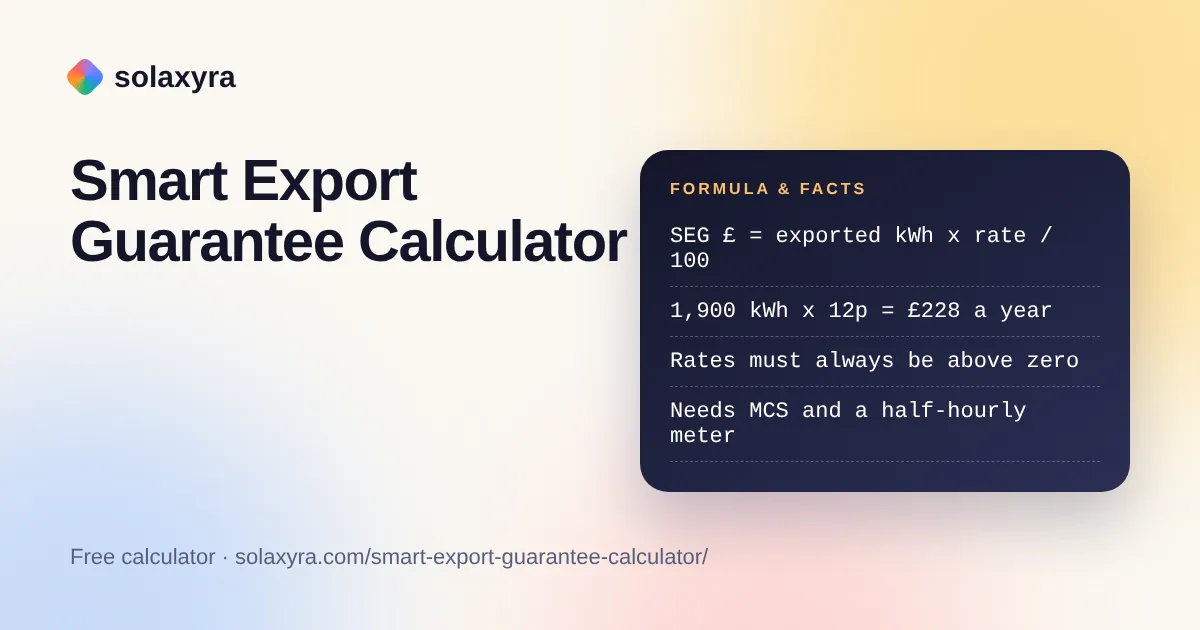
SEG earnings (£) = exported kWh x export rate (p) / 100. For two rates: average rate = peak share x peak rate + (1 − peak share) x off-peak rate.
n/a
This smart export guarantee calculator estimates how much a UK household can earn each year by selling surplus solar electricity to a supplier under the Smart Export Guarantee (SEG). It works from your exported kWh, or from your generation and self-use share, and compares export income with the value of using that electricity at home.
Quick answer: A smart export guarantee calculator multiplies the electricity you export in a year by your SEG rate. Exporting 1,900 kWh at 12p per kWh earns £228 a year. Suppliers with at least 150,000 domestic customers must offer an SEG tariff, they set their own rates, and Ofgem requires every rate to stay above zero.
What Is a Smart Export Guarantee Calculator?
A smart export guarantee calculator is a tool that turns the solar electricity you send to the grid into an estimate of yearly SEG payments. The formula in plain words is: exported kWh multiplied by your export rate in pence, divided by 100 to give pounds. If you do not have export readings yet, exported kWh is your yearly generation multiplied by the share you do not use at home.
The SEG itself is a government-backed scheme that started on 1 January 2020. Ofgem explains on its Smart Export Guarantee page that it covers solar PV, wind, hydro and anaerobic digestion installations up to 5 MW, and micro combined heat and power up to 50 kW, and that SEG tariff rates must always be above zero. Ofgem also states that SEG payments are calculated using export meter readings, which is why a suitable meter is essential.
How Do You Use the Smart Export Guarantee Calculator?
- Choose how you know your export. Pick “I know my exported kWh” if you have a year of smart meter or supplier data. Otherwise, choose the estimate option.
- For an estimate, enter yearly generation from your installer’s quote or inverter app, and the share of that solar you use at home.
- Check your import unit rate. The default is the Ofgem price cap rate for direct debit from 1 October to 31 December 2026.
- Choose a single-rate tariff or a peak and off-peak tariff, then type in the rates from your supplier’s own tariff page. The defaults are examples only.
- Read your yearly and monthly SEG earnings, the bill saving from self-use and the extra value of each kWh you keep. Open the breakdown to see the full sum.
How Much Can You Earn From the Smart Export Guarantee?
You earn your exported kWh multiplied by your rate, so a home exporting 2,000 kWh a year receives £80 at 4p per kWh, £240 at 12p and £320 at 16p. The reference table later on this page shows more combinations, and the calculator above works out your own figure.
The rate is the part you can change most easily. Suppliers decide their own SEG rates and terms, so offers differ widely and can change at short notice. The Energy Saving Trust says that typically you will get around 12p for every unit you do not use yourself. As a dated example, when we opened Octopus Energy’s own Outgoing Octopus page on 7 October 2026, it listed 12p per kWh on a variable basis, and a separate fixed-term tariff paying 16p per kWh from 4pm to 7pm and 9p per kWh at other times. Treat those as a snapshot, not a recommendation, and always check the supplier’s current page before switching.
Who Has to Offer an SEG Tariff?
Any licensed electricity supplier with at least 150,000 domestic electricity customers must offer at least one SEG tariff, according to Ofgem’s guidance for suppliers. Suppliers below that size can join voluntarily. GOV.UK confirms that your SEG supplier does not need to be the same company that supplies your imported electricity, so you are free to shop around for the export side separately, although some suppliers state on their own tariff pages that particular export tariffs are only open to customers who also import from them.
What Do You Need to Qualify for SEG Payments?
To be paid under the SEG you need three things: an eligible installation, proof that the installation and installer are certified, and a meter that records half-hourly export. The GOV.UK Smart Export Guarantee guide sets out the rules:
- Certification through the Microgeneration Certification Scheme (MCS) or a scheme accredited as equivalent, such as the Flexi-Orb renewables scheme.
- A meter capable of half-hourly export readings, which is typically a smart meter.
- You apply directly to the SEG supplier you choose.
- You cannot receive SEG if you already get export payments under the Feed-in Tariffs scheme.
If your installation is unusual, for example a plug-in kit or a system without an MCS certificate, ask the supplier before you rely on SEG income in any payback sum.
Is It Better to Export Solar Power or Use It Yourself?
Using your own solar is usually worth about twice as much as exporting it, because each kWh you use avoids an import at 26.32p under the Ofgem cap, while an exported kWh earns your SEG rate. At a 12p export rate, every kWh you move from export to self-use adds about 14p of value. That is why running appliances in daylight, heating water with surplus solar and adding a battery often matter more than chasing the highest export rate. Our solar self-consumption calculator estimates how much of your generation you can use at home, and the solar savings calculator combines self-use and export into one yearly figure.
The exception is a peak export tariff paired with a battery. If the battery can export at a peak rate higher than your import rate, exporting at those times can pay more than using the power yourself. The smart export guarantee calculator flags this case in the breakdown.
SEG Earnings Reference Table
Yearly SEG earnings for different export volumes and example rates, worked out with the same formula as the smart export guarantee calculator above. The rates are illustrative only, not quotes from any supplier.
| Exported per year | At 4p per kWh | At 8p per kWh | At 12p per kWh | At 16p per kWh |
|---|---|---|---|---|
| 1,000 kWh | £40 | £80 | £120 | £160 |
| 1,500 kWh | £60 | £120 | £180 | £240 |
| 2,000 kWh | £80 | £160 | £240 | £320 |
| 2,500 kWh | £100 | £200 | £300 | £400 |
| 3,000 kWh | £120 | £240 | £360 | £480 |
Worked Example: Tom’s Export Income in Norwich
Tom in Norwich has a solar system that his inverter app shows generating 3,600 kWh a year. He works from home two days a week and estimates he uses 40% of the solar himself, so he exports 60%. He enters these figures in the smart export guarantee calculator.
- Exported electricity: 3,600 kWh x 60% = 2,160 kWh a year.
- On a single 12p example rate: 2,160 x 12 / 100 = £259.20 a year, or £21.60 a month.
- On a two-rate example of 16p at peak and 9p off-peak, with 15% of his export at peak, the average rate is 10.05p, giving £217.08 a year. The single rate pays more for Tom.
- His self-use of 1,440 kWh saves 1,440 x 26.32 / 100 = £379.01 on his bills, so export makes up about 41% of his total solar benefit of £638.21.
Tom also checks the solar payback calculator with his combined figure to see how export income affects his break-even year.
Frequently Asked Questions
How much can I earn from the Smart Export Guarantee?
Multiply the kWh you export in a year by your SEG rate in pence and divide by 100. A home exporting 1,900 kWh at 12p per kWh earns £228 a year. Earnings rise with larger systems and fall when you use more solar at home.
Who has to offer a Smart Export Guarantee tariff?
Ofgem says licensed electricity suppliers with at least 150,000 domestic electricity customers must offer at least one SEG tariff. Smaller suppliers may choose to offer one. Your SEG supplier does not have to be the company that supplies your imported electricity.
What do I need to qualify for SEG payments?
You need an eligible installation, such as solar PV up to 5 MW, an MCS certificate or an equivalent certification, and a meter that records half-hourly export, which is usually a smart meter. You cannot get SEG while receiving export payments under the Feed-in Tariff scheme.
Is there a minimum SEG rate?
There is no fixed minimum in pence. Ofgem only requires that every SEG tariff rate is always above zero. Suppliers choose their own rates and terms, so rates differ widely and can change, which is why this calculator lets you type in your own rate.
Is it better to export solar power or use it myself?
Using it yourself is usually worth more. Each kWh you use avoids buying one at your import rate, 26.32p under the Ofgem cap from October 2026, while exporting earns only your SEG rate. Exporting wins only if your export rate is above your import rate.
How do I know how much electricity I export?
Your smart meter records export separately, and your SEG supplier or inverter app can show the total. Without readings, estimate it as yearly generation multiplied by the share you do not use at home, then refine that share once you have a few months of smart meter data.
Checked October 2026 by the Solaxyra Editorial Team. Sources: GOV.UK: Smart Export Guarantee, Ofgem: Smart Export Guarantee, Ofgem: SEG electricity suppliers, Ofgem: SEG guidance for generators, Energy Saving Trust: Solar panels, Ofgem: Energy price cap October to December 2026.