Estimate only. Savings depend on how much solar you use yourself, your tariff and your export rate.
Formula and breakdown
Savings in year n = first-year savings x (1 + price change)^(n − 1) x (1 − output loss)^(n − 1) − maintenance − inverter cost in its replacement year.
Payback is the point where cumulative savings equal the installed cost, interpolated within the year. Discounted payback divides each year’s savings by (1 + discount rate)^n first.
n/a
This solar payback calculator shows UK and European homeowners how many years it takes for solar panels to repay their installed cost, allowing for changing electricity prices, gradual panel output loss, maintenance and an inverter replacement. It also gives a simple payback figure, a discounted payback figure and the net gain over the life of the system.
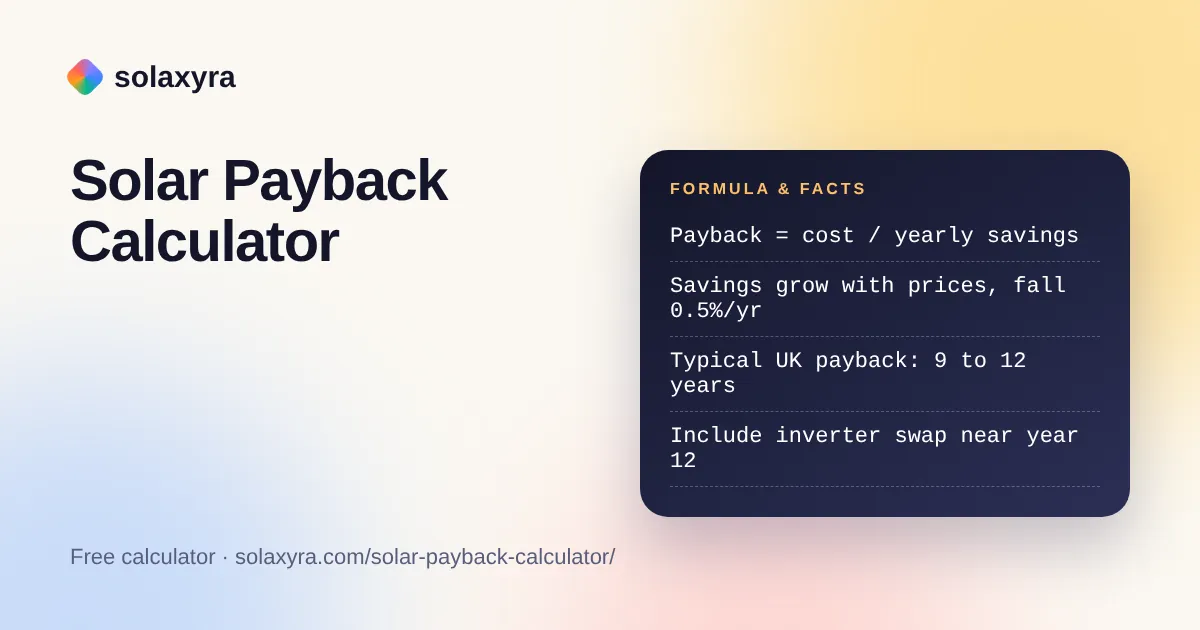
Quick answer: A solar payback calculator divides the installed cost by yearly savings, then adjusts each year for electricity price changes, panel output loss of about 0.5% a year and running costs. The Energy Saving Trust estimates 9 to 12 years for a typical UK system costing around £7,600, depending on location and how much solar you use at home.
What Is a Solar Payback Calculator?
A solar payback calculator is a tool that finds the point at which the money saved by solar panels equals the money spent installing them. In plain words, it takes your first-year savings, adjusts them up for each year of electricity price change and down for each year of panel ageing, subtracts any yearly running costs and one-off repairs, and adds the results year by year until the running total matches the installed cost.
The simplest version is a single division: installed cost divided by first-year savings. That figure is a useful starting point, but it ignores three things that pull in opposite directions over 25 years. Electricity prices tend to change, panels slowly lose output, and the inverter usually needs replacing at least once. This calculator models all three, so the answer is closer to what you will actually see on your bills.
How Do You Use the Solar Payback Calculator?
- Choose your currency. The maths is the same for pounds, euros or dollars.
- Enter the installed cost after any grant or discount. If you have a quote, use its total including scaffolding and VAT where charged.
- Enter your first-year savings plus export income. If you do not know this figure, work it out with our solar savings calculator first and copy the result here.
- Set the yearly electricity price change. Use 0 if you prefer not to guess, or test a few values to see the range.
- Leave panel output loss at 0.5% a year unless your panel warranty gives a different figure.
- Add maintenance, the inverter replacement cost and the year you expect to replace it.
- Set a discount rate if you want the discounted payback, then read the results and open the breakdown for the year-by-year table.
How Long Do Solar Panels Take to Pay for Themselves?
In the UK, typical solar panels take around 9 to 12 years to pay for themselves, according to the Energy Saving Trust solar panel guide. Its figures assume an average 4.5 kWp system costing about £7,600, include export payments and use fuel prices from July 2026. London comes out at about 9 years and Stirling at 11 to 12 years, because southern England receives more sunshine.
Where you live matters, but how much of your own solar you use matters just as much. Every kWh you use yourself avoids buying a kWh at the full unit rate, which under the Ofgem price cap from 1 October to 31 December 2026 is 26.32p per kWh for direct debit customers. Every kWh you export earns only your export rate, which is usually much lower. A household that runs the washing machine, dishwasher and hot water at midday will pay back sooner than an identical house that is empty all day.
Why Is My Payback Shorter Than the Simple Calculation?
Your payback is usually shorter than cost divided by savings because rising electricity prices increase the value of each kWh your panels produce. With the default inputs on this page, a 3% yearly price rise brings payback forward from 11.7 years (simple) to about 10.4 years, even after a £1,000 inverter replacement in year 12.
The opposite happens if prices stay flat. Using the same inputs with a 0% price change, payback stretches to about 13.7 years, because degradation slowly shrinks savings and the inverter cost lands before the system has broken even. That is why the solar payback calculator lets you test several price scenarios rather than relying on one number.
How Much Does Panel Degradation Affect Solar Payback?
Panel degradation typically adds only a few months to payback, because output falls by about 0.5% a year. That figure is the median of more than 2,000 measured degradation rates collected in an NREL review of PV module degradation, which also reported an average of 0.8% a year. At 0.5% a year, a system still produces about 89% of its first-year output in year 25. If your panel warranty guarantees a specific output after 25 or 30 years, you can convert it into a yearly rate and enter it in the solar payback calculator.
Should You Use Simple or Discounted Payback?
Use simple payback for a quick comparison between quotes, and discounted payback when you are deciding between solar and another use of the same money. Discounting divides each year’s savings by (1 + discount rate) raised to the number of years, so savings far in the future count for less. With a 3% discount rate and the default inputs, payback moves from about 10.4 to 13.6 years. If you want lifetime return figures such as ROI and IRR rather than a break-even year, use the solar ROI calculator, which runs the same kind of cash flow over the full system life.
Solar Payback Reference Table
The table below was produced with this solar payback calculator using a 3% yearly price rise, 0.5% yearly degradation, a £1,000 inverter replacement in year 12, a 3% discount rate and a 25-year life. It shows how strongly payback depends on the ratio between cost and savings.
| Installed cost | First-year savings | Simple payback | Payback with prices and costs | Discounted payback | Net gain over 25 years |
|---|---|---|---|---|---|
| £5,000 | £600 | 8.3 years | 7.7 years | 8.8 years | £14,455 |
| £5,000 | £800 | 6.3 years | 5.9 years | 6.5 years | £21,273 |
| £7,600 | £600 | 12.7 years | 12.4 years | 14.7 years | £11,855 |
| £7,600 | £800 | 9.5 years | 8.6 years | 10.0 years | £18,673 |
| £7,600 | £1,000 | 7.6 years | 7.0 years | 8.0 years | £25,491 |
| £10,000 | £600 | 16.7 years | 15.3 years | 19.2 years | £9,455 |
| £10,000 | £800 | 12.5 years | 11.4 years | 14.2 years | £16,273 |
Notice the £7,600 and £600 row: payback with price rises is only slightly shorter than simple payback, because the inverter replacement falls in year 12, just before the system breaks even.
How Can You Shorten the Payback Period?
The fastest way to shorten payback is to use more of your solar electricity yourself, because a self-used kWh is worth roughly twice an exported one at typical UK rates. Practical steps include:
- Run dishwashers, washing machines and tumble dryers between late morning and mid-afternoon on sunny days.
- Fit a solar diverter so surplus power heats your hot water cylinder instead of going to the grid.
- Charge an electric car at home in daylight where possible.
- Compare export tariffs every year. Our Smart Export Guarantee calculator shows what different export rates are worth for your system.
- Get at least three quotes from certified installers, since a lower installed cost shortens payback directly.
To see how much of your generation you are likely to use at home, try the solar self-consumption calculator before you settle on a system size.
Worked Example: Priya’s 4.8 kWp System in Bristol
Priya in Bristol paid £8,200 for a 4.8 kWp system. Her installer’s estimate, combined with her export tariff, gives first-year savings and export income of £720. She budgets £40 a year for monitoring and occasional cleaning, and expects to replace the inverter for about £1,100 in year 12. She assumes electricity prices rise 3% a year, panels lose 0.5% a year, and uses a 3.5% discount rate because that is what her savings account pays. She enters these figures in the solar payback calculator.
- Simple payback: £8,200 divided by £720 is 11.4 years.
- With price rises, degradation, maintenance and the inverter, cumulative savings pass £8,200 after about 10.6 years.
- Discounted at 3.5%, payback moves to about 14.4 years.
- Over 25 years her total net savings are about £22,446, a net gain of about £14,246 after the original cost.
Priya now knows that even in the cautious discounted case, her system repays itself well within its expected life.
Frequently Asked Questions
How long do solar panels take to pay for themselves in the UK?
The Energy Saving Trust estimates around 9 to 12 years for a typical 4.5 kWp system costing about £7,600, depending on where you live and whether someone is at home in the day. Homes that use more of their own solar pay back faster.
What is the difference between simple and discounted payback?
Simple payback divides the cost by yearly savings and treats money in year 15 as worth the same as money today. Discounted payback reduces each future year’s savings by a discount rate, so it is always longer and gives a fairer comparison with other uses of the money.
Does panel degradation make a big difference to payback?
Usually only a few months. An NREL review of over 2,000 measurements found a median output loss of 0.5% a year, so a system still produces roughly 89% of its first-year output in year 25. Rising electricity prices normally outweigh that loss.
Should I include an inverter replacement in the payback?
Yes, if the payback period or system life runs past about 12 years, which is when the Energy Saving Trust says the inverter usually needs replacing. Enter your quoted replacement cost and the year, and the calculator subtracts it from that year’s savings.
What counts as yearly savings for a solar payback calculation?
Yearly savings are the electricity you no longer buy, valued at your unit rate, plus any export payments such as the Smart Export Guarantee. Do not include the standing charge, because you still pay it with solar panels.
Does a battery shorten or lengthen solar payback?
It depends on the extra savings compared with the extra cost. A battery raises the share of solar you use yourself, but the Energy Saving Trust puts typical battery costs at £5,000 to £8,000, so the combined payback is often longer than panels alone.
Checked October 2026 by the Solaxyra Editorial Team. Sources: Energy Saving Trust: Solar panels, NREL: Technology and Climate Trends in PV Module Degradation, Ofgem: Energy price cap 1 October to 31 December 2026, GOV.UK: Smart Export Guarantee.