Bar shows the loss on a 0 to 20% scale. Output scaled to irradiance in a straight line, which is a simplification.
Formula and breakdown
This solar panel temperature loss calculator estimates how hot your solar cells get and how many watts they lose as a result, using the temperature coefficient and NOCT printed on your own panel’s datasheet. It suits homeowners and installers in the UK and Europe, and anyone comparing panels for a warmer climate, with Celsius or Fahrenheit input.
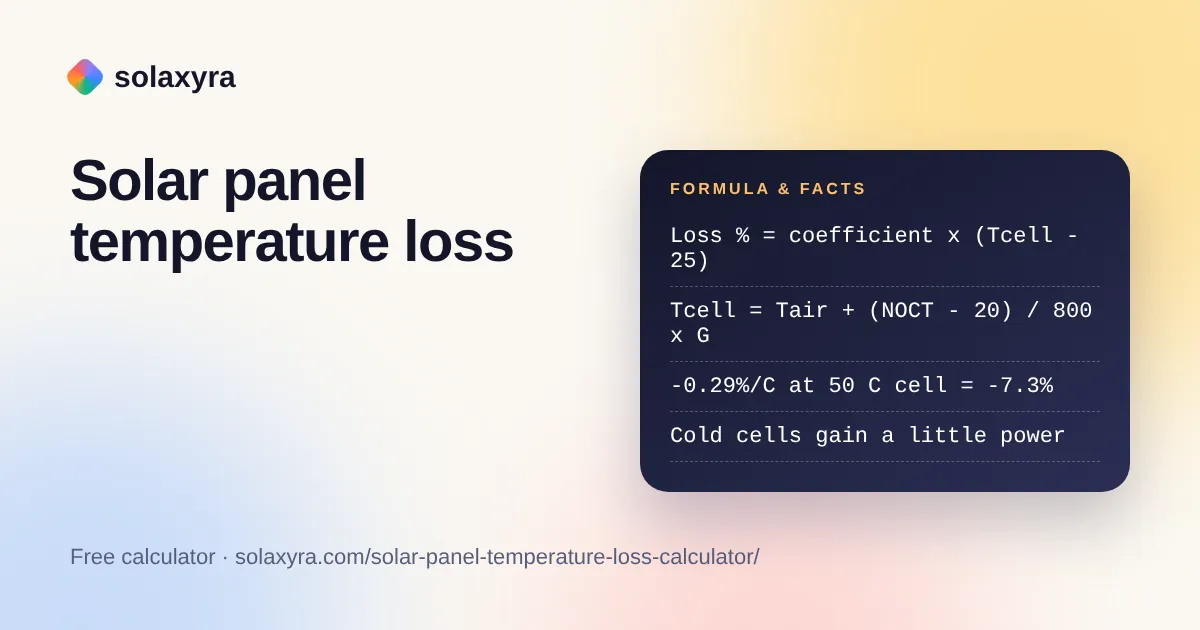
Quick answer: A solar panel temperature loss calculator multiplies the datasheet temperature coefficient of Pmax by how far the cells are above 25 C. At -0.29% per C, cells at 50 C lose 0.29 x 25 = 7.3% of power. A panel with a NOCT of 45 C runs about 25 C above air temperature in 800 W/m2 sunshine.
What Is a Solar Panel Temperature Loss Calculator?
A solar panel temperature loss calculator is a tool that converts a panel’s cell temperature into the percentage of power gained or lost compared with its 25 C rating. Solar panels are rated at standard test conditions, which the European Commission’s PVGIS manual defines as 1,000 W/m2 of sunlight at a panel temperature of 25 C. Crystalline silicon loses power as it warms, so on a real roof the panel almost never delivers its full label rating.
In plain words, the calculator does three things:
- Cell temperature = air temperature + (NOCT − 20) / 800 x irradiance. This simple model scales the NOCT temperature rise in proportion to the sunlight.
- Power change (%) = temperature coefficient of Pmax x (cell temperature − 25).
- Power (W) = rated power x irradiance / 1,000 x (1 + power change / 100).
The irradiance step is a straight-line simplification. Panel efficiency also shifts a little with light level, so treat results below about 200 W/m2 as rough.
How Do You Use the Solar Panel Temperature Loss Calculator?
- Pick Celsius or Fahrenheit. The coefficient always stays in % per C, as on datasheets.
- Enter the panel rating (Pmax) and the number of panels.
- Copy the temperature coefficient of Pmax from the datasheet, for example -0.29.
- Enter the sunlight on the panel in W/m2: 1,000 for full summer sun, 800 for the NOCT test level, less for hazy or low-sun conditions.
- Either enter the air temperature and the datasheet NOCT, or switch to “I know the cell temperature” if you have a reading from a thermal camera or sensor.
- Read the percentage change, the watts per panel and the watts lost across the whole array.
How Much Power Do Solar Panels Lose in Hot Weather?
A current panel loses roughly 0.3% of its power for every 1 C the cells rise above 25 C, so a cell at 55 C loses around 9%. The exact figure is the temperature coefficient of Pmax on the datasheet. The JinkoSolar Tiger Neo 54HL4R-B datasheet, a current N-type panel, lists -0.29% per C for Pmax. The same sheet lists -0.25% per C for open-circuit voltage and +0.045% per C for short-circuit current: current rises slightly with heat while voltage falls faster, so power drops.
| Cell temperature | Coefficient -0.29%/C | Coefficient -0.35%/C | Coefficient -0.40%/C |
|---|---|---|---|
| 5 C | +5.8% | +7.0% | +8.0% |
| 15 C | +2.9% | +3.5% | +4.0% |
| 25 C (STC) | 0% | 0% | 0% |
| 35 C | -2.9% | -3.5% | -4.0% |
| 45 C | -5.8% | -7.0% | -8.0% |
| 55 C | -8.7% | -10.5% | -12.0% |
| 65 C | -11.6% | -14.0% | -16.0% |
The -0.35 and -0.40 columns are example coefficients for comparison, not figures for a particular product. Always use the value on your own datasheet.
How Hot Do Solar Panels Get Compared With the Air?
At 800 W/m2 on an open rack, the cells of standard silicon panels run roughly 22 to 32 C above the air temperature, and NOCT tells you where your panel sits in that range. NOCT is measured at 800 W/m2 of sunlight, 20 C air and 1 m/s wind with the module on an open rack at a 45 degree tilt, according to an NREL study on measuring NOCT. That study quotes California Energy Commission data in which NOCT for rack-mounted standard silicon modules ranged from 41.6 to 52.3 C, so a 45 C panel runs about 25 C above the air under those conditions.
Two practical points follow. Panels mounted close to a roof with little air gap usually run hotter than the open-rack NOCT test suggests. And wind helps: a breezy hot day can cost less than a still, warm one.
How Much Energy Is Lost to Heat Over a Year in the UK?
Over a full year the heat loss is far smaller than on a hot afternoon, because most hours are cool or the sun is weak. When PVGIS cannot model a specific panel technology, it applies an 8% loss of power from temperature effects as a generic value that it describes as reasonable for temperate climates. Southern Europe sees larger losses on summer afternoons, which is one reason why a sunnier location does not raise yearly output in direct proportion to sunshine.
To see how temperature, orientation and shading combine into a yearly figure for your own system, compare your meter readings in the kWh per kWp calculator, or estimate future output with the solar panel output calculator.
Do Solar Panels Produce More Power in Cold Weather?
Yes, for the same amount of sunlight a cold panel produces more power than a warm one, because the temperature coefficient works in reverse below 25 C. At -0.29% per C, cells at 5 C produce about 5.8% more than their rating per unit of light. This is why cold, clear spring days can show the highest instantaneous readings of the year, even though long summer days still produce the most energy.
Cold also raises panel voltage, which matters when designing strings for an inverter. The highest string voltage occurs on the coldest bright morning and must stay within the inverter’s limit. Check that with the solar string size calculator, and have the final design and any DC wiring done or checked by a qualified installer or electrician; in the UK, installation work must meet BS 7671.
Worked Example: Summer Afternoon in Manchester and Seville
James in Manchester has ten 445 W panels with a coefficient of -0.29% per C and a NOCT of 45 C. He wants to know what heat costs on a warm afternoon, and how the same panels would do at his sister Lucia’s house in Seville.
- Manchester, 20 C air, 800 W/m2: cell temperature = 20 + (45 − 20) / 800 x 800 = 45 C.
- Power change = -0.29 x (45 − 25) = -5.8%.
- Per panel: 445 x 800 / 1,000 = 356 W before heat loss, 356 x 0.942 = 335 W after. Array: about 3,354 W, with about 206 W lost to heat.
- Seville, 35 C air, 1,000 W/m2: cell temperature = 35 + 25 / 800 x 1,000 = 66.3 C.
- Power change = -0.29 x 41.3 = -12.0%. Per panel: 445 W falls to about 392 W. Array: about 3,918 W, with about 532 W lost to heat.
Seville still produces more because the sunlight is stronger, but heat takes twice the share. For James, the loss in Manchester is modest and a panel with a better coefficient would gain him little; in Seville it would be worth comparing coefficients more closely, alongside the panel’s efficiency.
Frequently Asked Questions
How much power does a solar panel lose per degree?
It loses the percentage shown as the temperature coefficient of Pmax on its datasheet for every degree Celsius the cells are above 25 C. A current N-type panel lists -0.29% per C, so 10 C of extra heat costs about 2.9% of its power.
Is cell temperature the same as air temperature?
No. In sunshine the cells run well above the air. A panel with a NOCT of 45 C is about 25 C hotter than the air at 800 W/m2 on an open rack with a light breeze, and panels fitted close to a roof with little airflow can run hotter still.
What does NOCT mean on a solar panel datasheet?
NOCT is the nominal operating cell temperature: the cell temperature a module reaches at 800 W/m2 of sunlight, 20 C air temperature and 1 m/s wind, mounted on an open rack. It is used with the air temperature and sunlight level to estimate the real cell temperature.
Do solar panels work better in cold weather?
Per unit of sunlight, yes. Below 25 C cell temperature the coefficient works in reverse, so power rises slightly. Cold, bright spring days can therefore produce strong peaks, although winter days are short and the sun is low, so total daily energy is still lower.
How much energy is lost to heat over a whole year?
Much less than on the hottest afternoon. When PVGIS has no technology-specific model it assumes an 8% loss of power from temperature effects, described as reasonable for temperate climates. Hotter climates lose more, and this calculator shows the loss at any single moment.
Which temperature coefficient should I use?
Use the temperature coefficient of Pmax, sometimes written as gamma, from your own panel’s datasheet. Do not use the Voc or Isc coefficients, which describe voltage and current. If the datasheet gives a positive number, treat it as a loss above 25 C.
Checked October 2026 by the Solaxyra Editorial Team. Sources: NREL, Measuring and Modeling Nominal Operating Cell Temperature, JinkoSolar Tiger Neo JKM430-455N-54HL4R-B datasheet, European Commission JRC PVGIS user manual.