Bar scale: 0 to 30%. Area per kWp counts panel area only, not gaps or roof edge clearance.
Formula and breakdown
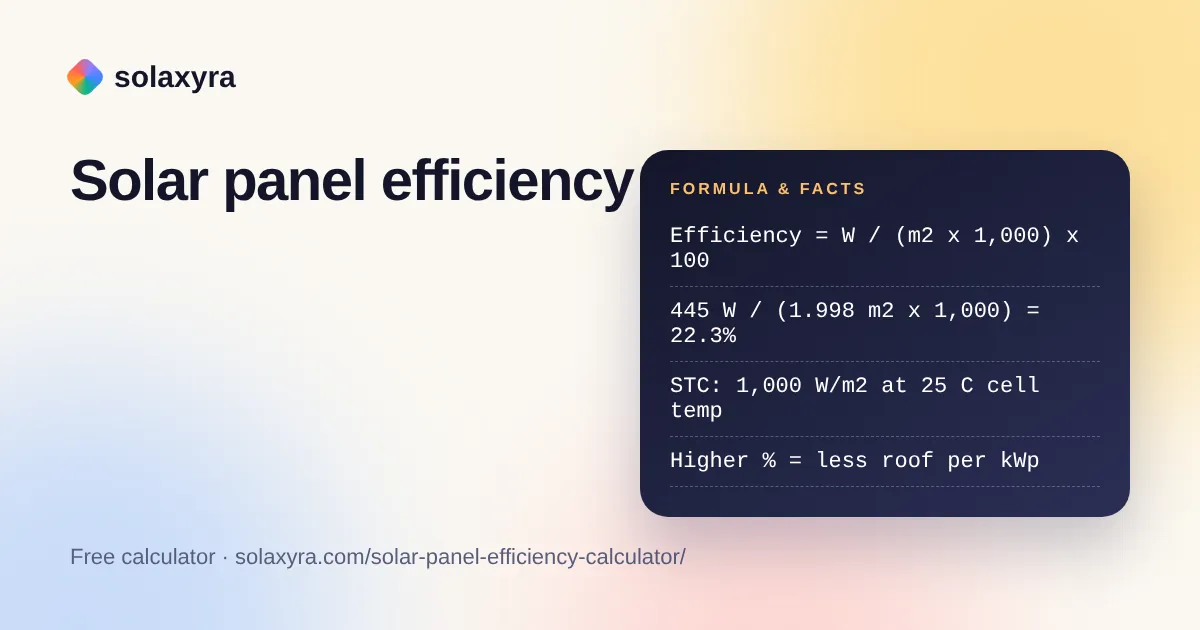
Efficiency = power out / (area x irradiance) x 100
This solar panel efficiency calculator works out what share of the sunlight hitting a panel it turns into electricity, using the rated watts and the frame size from the datasheet. It is built for homeowners, installers and students in the UK, Ireland and Europe who want to compare panels fairly or check how much roof a system will need, in millimetres or inches.
Quick answer: A solar panel efficiency calculator divides rated power by panel area times 1,000 W/m2, the standard test irradiance. A 445 W panel measuring 1,762 x 1,134 mm covers 1.998 m2, so its efficiency is 445 / 1,998 x 100 = 22.3%. Use the full frame size from the datasheet.
What Is a Solar Panel Efficiency Calculator?
A solar panel efficiency calculator is a tool that compares the electrical power a panel delivers with the solar power falling on its surface and expresses the result as a percentage. In plain words, you find the panel's area in square metres, multiply it by the sunlight per square metre, and divide the panel's power by that figure.
The formula is efficiency (%) = power (W) / (area (m2) x irradiance (W/m2)) x 100. For datasheet ratings the irradiance is always 1,000 W/m2, because panels are rated at standard test conditions (STC). The European Commission's PVGIS user manual describes STC as a constant 1,000 W of sunlight per square metre at an array temperature of 25 C, and manufacturer datasheets add an air mass of 1.5, which fixes the light spectrum.
The calculator also shows the power per square metre and the panel area needed for each kWp. Both come from the same sum and are often more useful when you are planning a roof.
How Do You Use the Solar Panel Efficiency Calculator?
- Choose millimetres or inches to match your datasheet.
- Leave the mode on "Datasheet rating" to check a panel's rated efficiency, or switch to "My own measurement" if you have a power reading and an irradiance meter.
- Enter the rated power (Pmax) in watts. For a measurement, enter the measured output instead.
- Enter the panel length and width from the mechanical drawing on the datasheet.
- Read the efficiency, the area, the watts per square metre and the area per kWp. Open the breakdown to see each step.
What Is a Good Solar Panel Efficiency?
There is no official pass mark: a good efficiency is one that compares well with other panels of a similar size and price, so run each datasheet through the formula and compare like with like. As an example, the JinkoSolar Tiger Neo 54HL4R-B datasheet lists models from 430 to 455 W in a 1,762 x 1,134 mm frame. That works out at about 21.5% for the 430 W model and 22.77% for the 455 W model, exactly the figure printed on the datasheet.
A higher number does not mean a better buy on its own. It means more watts on each square metre, which matters when roof space is the limit. On a large roof, a slightly less efficient panel at a lower price per watt can make more financial sense.
| Module efficiency | Power from a 1.998 m2 panel | Panel area per kWp | Panel area for 4.5 kWp |
|---|---|---|---|
| 18% | 360 W | 5.56 m2 | 25.0 m2 |
| 20% | 400 W | 5.00 m2 | 22.5 m2 |
| 22% | 440 W | 4.55 m2 | 20.5 m2 |
| 24% | 480 W | 4.17 m2 | 18.8 m2 |
Panel area only. Real roofs also need gaps between panels and clearance at the edges. The Energy Saving Trust says a typical 4.5 kWp home system covers about 20 to 30 m2 of roof, usually with around 12 panels. To see how many panels fit on your own roof, use the solar panel roof area calculator.
Does a More Efficient Panel Produce More kWh per kWp?
No, efficiency mainly changes how much roof you need, not how many kWh each kWp produces in a year. Two 4 kWp systems on the same roof, one built from 20% panels and one from 22% panels, will generate similar yearly energy, because both are rated at the same 4 kW under the same test light. The 22% system simply takes up less space.
Yearly output per kWp depends on location, orientation, shading, temperature and system losses. Government analysis of UK Feed-in Tariff meter readings found a median load factor of 9.2% in 2024/25, about 806 kWh per kWp, across panels of every efficiency. You can check your own system against that figure with the kWh per kWp calculator.
Why Is Real-World Efficiency Lower Than the Datasheet Figure?
Panels on a roof usually work below their rated efficiency because their cells run hotter than 25 C and the sunlight is rarely a full 1,000 W/m2. Heat matters most on bright days: crystalline panels lose a fixed share of power for every degree above 25 C, which the datasheet lists as the temperature coefficient of Pmax, for example -0.29% per C on the Tiger Neo sheet above.
When PVGIS cannot model a specific technology, it assumes an 8% power loss from temperature effects as a generic value for temperate climates, and it applies a default of 14% for other system losses such as cables, inverter and dirt. Our solar panel temperature loss calculator estimates the heat loss for your own panel and weather.
What Is the Difference Between Cell and Module Efficiency?
Cell efficiency counts only the active silicon area, while module efficiency counts the whole panel including the frame and the gaps between cells, so module efficiency is always the lower of the two. When you compare panels for a roof, use module efficiency, which is what this calculator works out from the outer dimensions.
Can You Measure Panel Efficiency on Your Own Roof?
You can estimate it, but expect an uncertainty of a few percentage points. Switch the tool to "My own measurement", enter the panel's output at that moment from a panel-level optimiser or microinverter, and the irradiance on the panel face from an irradiance meter held at the same angle. The calculator divides one by the other in the same way. Readings taken in strong, steady sunshine near 1,000 W/m2 compare best with the datasheet; on a hot day the result will also include the temperature loss described above. Never open junction boxes or disconnect DC cables to take a reading: DC circuits from panels stay live in daylight, and any electrical work must be done by a qualified installer or electrician.
Worked Example: Comparing Two Panels for a Roof in Bristol
Priya in Bristol has room for exactly ten panels and is choosing between two quotes.
- Panel A: 445 W, 1,762 x 1,134 mm. Area = 1.762 x 1.134 = 1.998 m2. Efficiency = 445 / (1.998 x 1,000) x 100 = 22.3%.
- Panel B: 410 W, 1,722 x 1,134 mm. Area = 1.953 m2. Efficiency = 410 / 1,953 x 100 = 21.0%.
- Ten of panel A give 4.45 kWp; ten of panel B give 4.10 kWp.
- At the UK median of about 806 kWh per kWp, A could make about 3,587 kWh a year and B about 3,305 kWh.
Because her roof space is fixed, the more efficient panel adds about 280 kWh a year. If the roof had room for twelve of panel B, the difference would mostly disappear, and price per watt would decide. For a full output estimate by month, try the solar panel output calculator.
Frequently Asked Questions
How do you calculate solar panel efficiency?
Multiply the panel length by the width in metres to get its area, multiply that by 1,000 W/m2, then divide the rated power by the result and multiply by 100. A 445 W panel of 1.998 m2 gives 445 / 1,998 x 100 = 22.3%.
What is a good efficiency for a solar panel today?
Check the datasheet of the exact panel. One current example, an N-type panel range of 430 to 455 W in a 1,762 x 1,134 mm frame, works out at about 21.5 to 22.8%, with the 455 W version listed at 22.77%. A higher figure means more watts from the same roof area.
Does a more efficient panel produce more kWh per kWp?
Not by itself. Efficiency tells you how many watts fit on each square metre, so you need less roof for the same kWp. Yearly kWh per kWp depends mainly on location, orientation, shading, temperature and system losses.
Should I use the frame size or the cell area?
Use the full frame size. Manufacturers calculate module efficiency on the outer dimensions shown on the datasheet, so the frame, gaps between cells and edges are included. Using only cell area gives cell efficiency, which is always higher.
Why is my panel less efficient on the roof than on the datasheet?
The datasheet figure is measured at 25 C cell temperature and 1,000 W/m2. On a roof the cells are usually hotter, sunlight is weaker and dirt, wiring and inverter losses add up, so measured efficiency is normally lower than the rated value.
Can I measure my own panel efficiency at home?
Only roughly. You need the panel's power output at that moment and the irradiance on the panel face from a calibrated meter. Divide the power by area times irradiance. Small errors in either reading change the answer by several percentage points.
Checked October 2026 by the Solaxyra Editorial Team. Sources: European Commission JRC PVGIS user manual, JinkoSolar Tiger Neo JKM430-455N-54HL4R-B datasheet, Energy Saving Trust solar panels guide, DESNZ Feed-in Tariff load factor analysis 2024/25.