Standing charges stay on your bill with solar. Roof space assumes 1.95 m² per panel.
Formula and breakdown
n/a
n/a
n/a
n/a
This solar system size calculator starts from the figure most people know best, their electricity bill, and works back to the kWh you use and the solar system size in kWp that would generate the same amount over a year, for homes in the UK, Ireland and Europe. It removes the standing charge first, so the kWh estimate is not inflated, then shows the panel count, roof space and a first estimate of the yearly saving.
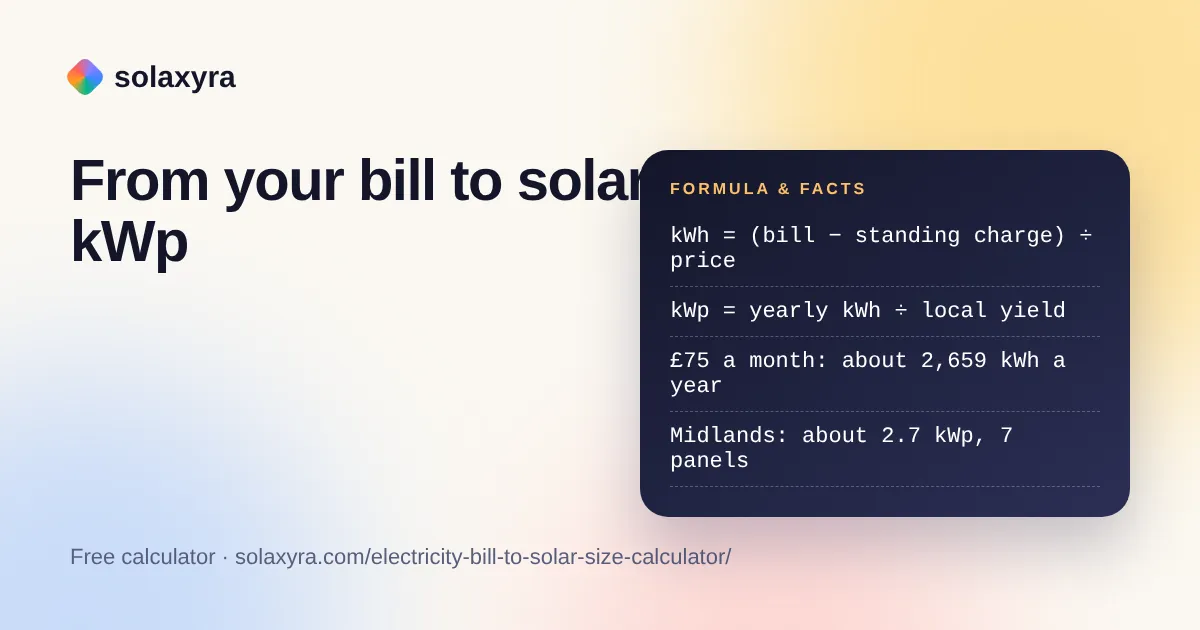
Quick answer: A solar system size calculator takes your electricity bill, subtracts standing charges, divides by your unit price to get kWh, then divides yearly kWh by local solar yield. A £75 monthly bill at 26.32p per kWh and 54.83p a day means about 2,659 kWh a year, or a 2.7 kWp system in the English Midlands.
What Is a Solar System Size Calculator?
A solar system size calculator is a tool that estimates the kWp of solar panels a home needs, here worked out from an electricity bill rather than a meter reading. The formula in plain words takes three steps. First, the energy part of the bill equals the bill minus the standing charge for the days covered. Second, kWh used equals that energy cost divided by the unit price. Third, system size equals yearly kWh times the share you want to cover, divided by the kWh each kWp produces where you live, adjusted for roof direction.
The yield figures come from the World Bank Global Solar Atlas and are long-term averages for a typical system at the best fixed angle. UK defaults for price and standing charge are the Ofgem energy price cap for 1 October to 31 December 2026: 26.32p per kWh and 54.83p per day for electricity paid by direct debit. Replace them with the figures on your own bill, because rates vary by region, tariff and payment method.
How Do You Use the Solar System Size Calculator?
- Choose whether your bill is monthly, quarterly or yearly, and the currency.
- Enter the electricity part of the bill only. If you have a dual fuel bill, leave out the gas.
- Enter your unit price and daily standing charge from the bill. If your tariff has no standing charge, enter 0.
- Pick your region; the yield box fills automatically. You can type in a figure from an installer quote instead.
- Choose your roof direction, the share of use you want to cover and the panel wattage.
- Optionally set how much solar electricity you expect to use at home and your export rate to see an estimated saving.
How Do You Work Out kWh From an Electricity Bill?
Subtract the standing charge for the billing period, then divide what is left by your unit price: a £75 monthly bill minus about £16.68 in standing charges leaves £58.32, and £58.32 ÷ 26.32p is about 222 kWh a month. Multiply a monthly figure by 12, or a quarterly figure by 4, to get a yearly estimate.
Two cautions apply. A single winter or summer bill is not typical of the year, because many homes use more electricity in the darker months, so a year of bills or your annual statement gives a better figure. And if you pay a fixed monthly direct debit, the payment is an average set by your supplier rather than what you used, so check the kWh shown on the statement where possible. If you already know your yearly kWh, the solar panel calculator skips the bill step.
What Size Solar System Do I Need for My Bill?
At UK price cap rates in the Midlands, every £25 a month on your electricity bill corresponds to roughly 1.2 kWp of south-facing solar needed to match your yearly use. The table shows the results for a range of monthly bills using 26.32p per kWh, 54.83p per day and 430 W panels on a south-facing roof.
| Monthly electricity bill | Yearly use (kWh) | System size needed | Panels of 430 W | Expected generation (kWh a year) |
|---|---|---|---|---|
| £40 | 1,063 | 1.09 kWp | 3 | 1,259 |
| £60 | 1,975 | 2.02 kWp | 5 | 2,098 |
| £75 | 2,659 | 2.72 kWp | 7 | 2,938 |
| £100 | 3,799 | 3.89 kWp | 10 | 4,197 |
| £125 | 4,939 | 5.06 kWp | 12 | 5,036 |
| £150 | 6,079 | 6.23 kWp | 15 | 6,295 |
In southern Europe the same use needs a smaller system: about 40% smaller in Madrid, where each kWp produces about 1,655 kWh a year against 976 kWh in the Midlands.
Will Solar Panels Wipe Out My Electricity Bill?
No, solar panels sized to match your yearly use remove only part of the bill: with the calculator's example settings and no battery, a little over 40% of a UK electricity bill. There are three reasons. The standing charge stays, because you are still connected to the grid. Panels produce little in winter and nothing at night, so you still buy electricity then. And the surplus you export on sunny afternoons earns only the export rate your supplier offers, which can be well below the import price or nothing at all.
The calculator shows this with the "share of the bill this removes" row. With the default £75 bill, half of the solar used at home and no export payment, the saving is about £387 a year, or 43% of the bill. Raising self-use with timers, a hot water diverter or a battery pushes that share up; the solar self-consumption calculator helps estimate how far, and the solar payback calculator turns the saving into a payback year.
Any roof-mounted system is wired into your consumer unit, so it must be designed and installed by a qualified installer, with the electrical work done by a registered electrician to BS 7671 in the UK, or to local wiring rules elsewhere.
Worked Example: Sarah in Manchester
Sarah gets a quarterly electricity bill of £240. Her bill shows a unit rate of 26.32p per kWh and a standing charge of 54.83p a day. Her roof faces south west and she wants to generate as much as she uses in a year with 430 W panels.
- Standing charge for the quarter: 54.83p × 91.25 days = about £50.03.
- Energy part of the bill: £240 minus £50.03 = £189.97.
- kWh used: £189.97 ÷ 26.32p = about 722 kWh a quarter, or 2,887 kWh a year.
- System size: 2,887 kWh ÷ (920 kWh per kWp in the North West × 95% for a south west roof) = 3.30 kWp.
- Panels: 8 × 430 W = 3.44 kWp, generating about 3,007 kWh a year and needing about 16 m² of roof.
- Saving: if she uses half the output at home and is paid nothing for exports, about £396 a year, or 41% of her £960 yearly bill.
Because her bill covers a summer quarter, Sarah checks her annual statement before asking for quotes. It shows 3,100 kWh, so she plans for 9 panels.
Frequently Asked Questions
How do I size a solar system from my electricity bill?
Subtract the standing charge from the bill, divide the rest by your unit price to get kWh, and scale it to a full year. Then divide yearly kWh by your local yield in kWh per kWp. At UK price cap rates, a £75 monthly bill points to about a 2.7 kWp system in the Midlands.
Why does the calculator remove the standing charge?
The standing charge is a fixed daily fee for being connected, and it does not depend on how much electricity you use. Leaving it in would overstate your kWh use and suggest a larger solar system than you need. Solar panels do not reduce the standing charge either.
Can I use a gas and electricity bill?
Use the electricity part only. A dual fuel bill lists gas and electricity separately, each with its own unit rate and standing charge. Solar panels generate electricity, so gas costs should be left out unless you plan to switch heating to a heat pump.
What if my bill is a fixed direct debit?
A fixed direct debit is an average your supplier sets in advance and may be higher or lower than your real use. Use the kWh figure on your annual statement or the units shown on recent bills, and select the yearly period if you enter a full-year cost.
How many solar panels do I need for a £100 monthly bill?
At 26.32p per kWh and 54.83p a day, a £100 monthly electricity bill means about 3,800 kWh a year. In the English Midlands that needs about 3.9 kWp on a south roof, which is 10 panels of 430 W, generating about 4,200 kWh a year.
Should I size solar for future electric car or heat pump use?
If you expect to add an electric car or heat pump soon, enter a higher share of use to cover, or add the expected kWh to your bill figure. Fitting extra panels during the first installation is usually simpler than adding them later, provided the roof has space.
Checked October 2026 by the Solaxyra Editorial Team. Sources: Ofgem price cap October to December 2026, Global Solar Atlas (World Bank), EU Joint Research Centre PVGIS.