Running current only. Motors and compressors draw more for a moment at start-up.
Formula and breakdown
n/a
n/a
This watts to amps converter tells you how much current an appliance, heater, motor or battery load draws, with UK and European voltages (230 V single-phase, 400 V three-phase) set as defaults and 120 V and 240 V one click away. Our watts to amps calculator handles DC, single-phase AC and three-phase AC, and lets you add power factor and motor efficiency so the answer matches real equipment rather than an idealised heater.
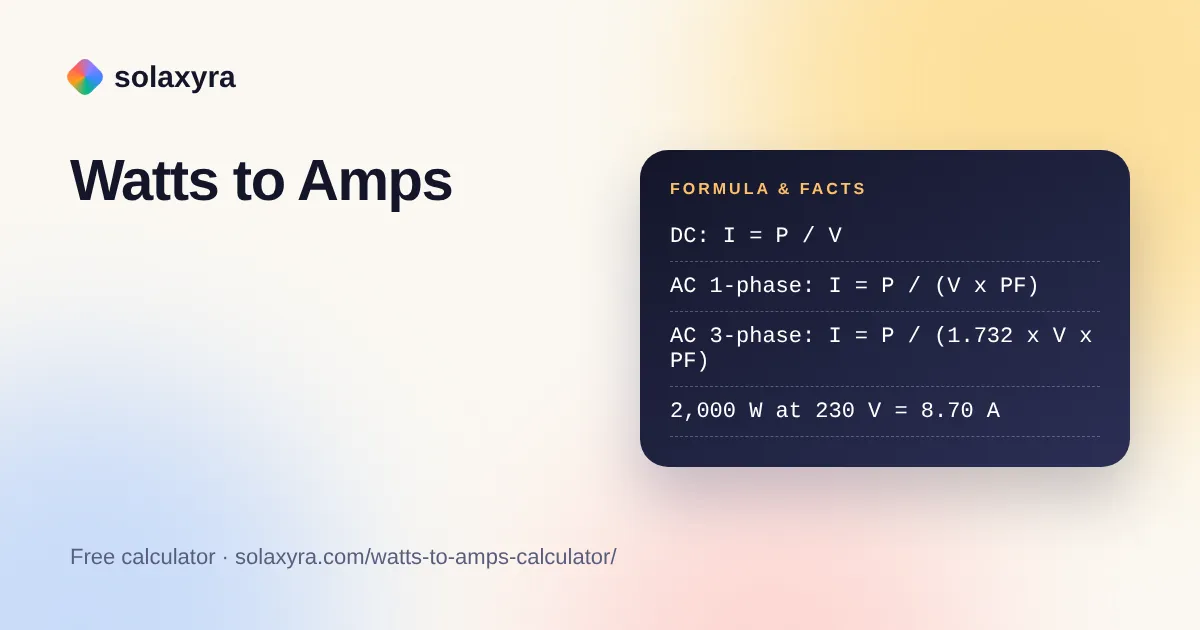
Quick answer: A watts to amps calculator divides power by voltage: I = P / V for DC, I = P / (V x PF) for single-phase AC and I = P / (1.732 x V x PF) for three-phase AC. So 2,000 W at 230 V and power factor 1 draws 8.70 A; at 120 V it draws 16.67 A.
What Is a Watts to Amps Calculator?
A watts to amps calculator is a tool that converts the power a device uses, in watts, into the electrical current it draws, in amperes, for a given supply voltage. In plain words, current equals power divided by voltage; on AC supplies you also divide by the power factor, and on a three-phase supply you divide by the square root of 3 (about 1.732) as well, because the power is shared across three lines.
Watts and amps are not interchangeable units. Since the old 220/380 V and 240/415 V systems were replaced by a harmonised 230/400 V European standard, 230 V is the right default for UK and EU sockets. Watts measure the rate of energy use, amps measure the flow of charge, and the voltage links the two. That is why a 2 kW kettle draws about half the current in a British kitchen that it would on a North American 120 V circuit.
How Do You Use the Watts to Amps Calculator?
- Choose the supply: AC single-phase for normal household sockets, AC three-phase for commercial and some domestic supplies, or DC for batteries, solar and vehicles.
- Enter the power and pick watts or kilowatts. Use the input power on the rating plate where possible.
- Enter the voltage or choose a preset. For three-phase, say whether your voltage is line to line (400 V in the UK and EU) or line to neutral (230 V).
- Set the power factor. Leave it at 1 for heaters, kettles and filament lamps; enter the rating plate value for motors and compressors.
- If the watts are a motor's mechanical output rather than its electrical input, enter the motor efficiency so the tool works back to input power.
- Read the current, the apparent power in VA, the current the load would draw at power factor 1, and a comparison at another voltage. Open the breakdown to see every step.
What Are the Watts to Amps Formulas for DC, Single-Phase and Three-Phase?
There are three formulas, and picking the wrong one is the most common mistake: use I = P / V for DC, I = P / (V x PF) for single-phase AC, and I = P / (1.732 x V x PF) for balanced three-phase AC with line to line voltage.
- DC: current = watts / volts. A 60 W camping fridge on 12 V draws 5 A.
- Single-phase AC: current = watts / (volts x power factor).
- Three-phase AC, line to line voltage: current per line = watts / (1.732 x volts x power factor).
- Three-phase AC, line to neutral voltage: current per line = watts / (3 x volts x power factor).
The 1.732 factor comes from the geometry of three-phase supplies. In the European 230/400 V system described in the three-phase electric power reference, 230 V is measured from each phase to neutral and 400 V between any two phases, and 400 is 230 multiplied by the square root of 3. Both versions of the formula give the same current if you use the matching voltage. For deeper three-phase work, including kVA and kVAr, use the three-phase power calculator.
How Many Amps Is 1,000 Watts at 230 V?
1,000 W at 230 V single-phase draws 4.35 A when the power factor is 1, which is the case for resistive loads such as heaters and kettles. At 240 V the same load draws 4.17 A, and at 120 V it draws 8.33 A. The table below repeats the sum for common sizes.
| Power (W) | 230 V single-phase (A) | 240 V single-phase (A) | 120 V single-phase (A) | 400 V three-phase, per line (A) | 12 V DC (A) |
|---|---|---|---|---|---|
| 100 | 0.43 | 0.42 | 0.83 | 0.14 | 8.3 |
| 500 | 2.17 | 2.08 | 4.17 | 0.72 | 41.7 |
| 1,000 | 4.35 | 4.17 | 8.33 | 1.44 | 83.3 |
| 2,000 | 8.70 | 8.33 | 16.67 | 2.89 | 166.7 |
| 3,000 | 13.04 | 12.50 | 25.00 | 4.33 | 250.0 |
| 5,000 | 21.74 | 20.83 | 41.67 | 7.22 | 416.7 |
| 7,400 | 32.17 | 30.83 | 61.67 | 10.68 | 616.7 |
| 10,000 | 43.48 | 41.67 | 83.33 | 14.43 | 833.3 |
All values assume a power factor of 1. Divide by your power factor for inductive loads, so a 1,000 W load at PF 0.8 on 230 V draws 4.35 / 0.8 = 5.43 A. The 12 V column shows why low-voltage DC systems need thick cables: the same power needs about 19 times the current of a 230 V circuit.
Why Does Power Factor Change the Current?
A power factor below 1 raises the current for the same useful watts, because the supply must also carry reactive current that flows back and forth without doing work. Power factor is defined as real power divided by apparent power, and the power factor reference article notes that resistive loads such as heaters sit at almost 1 while motors and transformers can be well below 1.
In numbers: at PF 0.7 a load draws about 1.43 times the current it would draw at PF 1. That extra current heats cables and trips breakers even though your energy meter only records the real watts. If you know watts and volt-amperes from a plug-in meter, the power factor calculator works out the factor for you.
Is the Rated Wattage the Same as the Current a Device Draws?
Not always: the wattage on a label is usually the input power for heaters and appliances, but for electric motors it is often the mechanical output, so the electrical input, and therefore the current, is higher. A motor rated 1.5 kW output at 85% efficiency takes about 1,765 W from the supply. Enter the efficiency in the calculator to correct for this.
Two other gaps between label and reality are worth knowing:
- Start-up current. Induction motors started directly can draw 7 to 10 times their running current for a moment, and compressors and some power supplies also surge when switched on. The calculator shows running current only.
- Thermostat cycling. A 2 kW oil-filled radiator draws its full 8.7 A only while the element is on; averaged over an hour the current is lower, but the circuit must still carry the full figure.
The result tells you current, not which cable, fuse or breaker to fit. Those depend on cable length, installation method, grouping and temperature. In the UK, new circuits and alterations must meet BS 7671 and should be designed and installed by a registered electrician; elsewhere, follow your national wiring rules and use a qualified installer.
Worked Example: Marek's Workshop in Leeds
Marek is fitting out a garage workshop on a 230 V single-phase supply and wants to know the running current of three items before he asks an electrician to add a circuit.
- Fan heater, 3 kW, resistive. I = 3,000 / (230 x 1) = 13.04 A.
- Air compressor, motor rated 1.5 kW output, 85% efficient, PF 0.8. Input power = 1,500 / 0.85 = 1,765 W. I = 1,765 / (230 x 0.8) = 9.59 A.
- LED lighting, 120 W, PF 0.9. I = 120 / (230 x 0.9) = 0.58 A.
Running together, the three draw about 23.2 A, before the compressor's start-up surge. Marek notes that the compressor draws more current than its 1.5 kW label suggests because of efficiency and power factor. He takes the total to his electrician, who will size the circuit under BS 7671. To turn the same figures into running costs, Marek uses the amps to watts calculator, which adds hours of use and a unit price.
Frequently Asked Questions
How many amps is 2,000 watts?
2,000 watts draws 8.70 A at 230 V, 8.33 A at 240 V and 16.67 A at 120 V, assuming a power factor of 1. On a 400 V three-phase supply it draws 2.89 A in each line. On a 12 V battery it would draw about 167 A.
How do I convert watts to amps without knowing the voltage?
You cannot convert watts to amps without a voltage, because current depends on both. Use the nominal supply voltage instead: 230 V for UK and EU sockets, 120 V in North America, or the battery voltage for DC systems. The result will be close enough for planning.
Should I use 230 V or 240 V in the UK?
Use 230 V, the harmonised nominal voltage for the UK and the rest of Europe, which replaced the old British 240 V standard. Some older labels still show 240 V, and the real voltage varies a little. The difference changes the answer by only about 4%.
What is the difference between line to line and line to neutral voltage?
Line to line voltage is measured between two phases of a three-phase supply, typically 400 V in the UK and EU. Line to neutral voltage is measured from one phase to neutral, typically 230 V. Use the matching formula: 1.732 times line voltage, or 3 times phase voltage.
Can I use the watts to amps formula for a battery inverter?
Yes, but divide the AC load by the inverter efficiency first, then by the battery voltage. A 1,000 W load through a 90% efficient inverter on a 12 V battery draws about 1,111 / 12 = 93 A from the battery, far more than many people expect.
What power factor should I use if the label does not show one?
Use 1 for heaters, kettles, toasters and filament lamps, which are resistive. For motors, pumps and compressors without a stated value, many people assume a power factor of 0.8 as a cautious planning figure. Measure with a plug-in power meter that shows VA and W if you need accuracy.
Checked October 2026 by the Solaxyra Editorial Team. Sources: Wikipedia, Power factor, Wikipedia, Three-phase electric power, Wikipedia, Volt-ampere, Wikipedia, Mains electricity by country, Wikipedia, Motor soft starter.