This guide explains how the Smart Export Guarantee pays households in Great Britain for electricity they send to the grid from solar panels and other small generators, who must offer it, what it pays in practice and how to choose and apply for a tariff. With the smart export guarantee explained using Ofgem’s own figures, you can judge how much export income is realistic and whether using your solar at home is worth more.
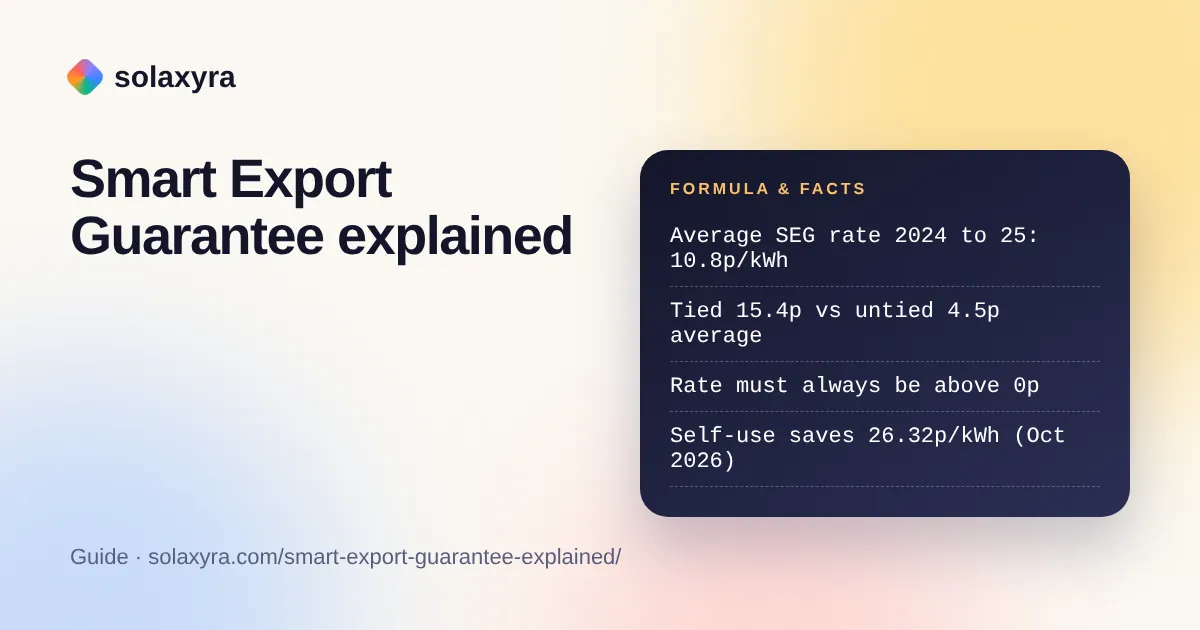
Quick answer: With the Smart Export Guarantee explained simply, larger electricity suppliers in Great Britain must pay you for low-carbon electricity you export, such as surplus solar. Each supplier sets its own rate, which must stay above zero, and pays per kWh your export meter records. Ofgem’s latest annual report shows an average rate of 10.8p per kWh.
What is the Smart Export Guarantee?
The Smart Export Guarantee (SEG) is a government-backed scheme, running since 1 January 2020, that requires certain electricity suppliers to pay small-scale generators for low-carbon electricity they export to the grid. According to Ofgem’s SEG guidance, these suppliers are called SEG licensees, and they decide the rate, contract length and other terms themselves. Ofgem does not set the rate.
The one fixed rule on price is that SEG tariff rates must always be above zero. That means a supplier can offer a low rate, but it cannot charge you for exporting or pay nothing at times of surplus. The scheme only covers installations located in Great Britain, so Northern Ireland is not included.
SEG pays for exports only. Electricity you generate and use yourself earns nothing from SEG, but it saves you buying that unit from the grid, and as the table further down shows, that saving is usually worth more than the export payment.
Who has to offer SEG, and who can get paid?
Every electricity supplier with at least 150,000 domestic electricity customers must offer at least one SEG tariff, and smaller suppliers may choose to. Ofgem’s annual report for April 2024 to March 2025 lists 11 SEG licensees offering 50 tariffs between them.
To be eligible, your installation must use one of these technologies and stay within the size limit:
- solar photovoltaic (solar PV);
- wind;
- hydro;
- anaerobic digestion;
- micro combined heat and power (micro-CHP), up to 50 kW.
All other technologies are eligible up to 5 MW, far above any home system. Solar, wind and micro-CHP installations up to 50 kW need a Microgeneration Certification Scheme (MCS) certificate or an equivalent, which is why a professionally installed rooftop system comes with MCS paperwork. Payments are calculated from export meter readings, so you also need a meter that records exports; in practice this is usually a smart meter, and the supplier will tell you what it accepts.
Ofgem’s report shows that solar PV made up 99.98% of SEG installations at the end of the year, so for almost every household SEG is a solar question.
How much does the Smart Export Guarantee pay?
Ofgem’s Year 5 annual report puts the average SEG rate across all tariffs at 10.8p per kWh, but the range runs from 1p to 40p per kWh, and the type of tariff makes the biggest difference. The Ofgem SEG annual report for April 2024 to March 2025 gives these figures:
- Total paid to generators: £56.97 million, up 86% on the year before.
- Total exported: 443.1 GWh.
- Installations registered at year end: 270,395.
- Average tied tariff: 15.4p per kWh. Average untied tariff: 4.5p per kWh.
- Highest untied rate: 12p per kWh. Lowest rate: 1p per kWh.
A tied tariff is one you can only get if you also buy your electricity from the same supplier, or meet another condition such as owning certain equipment. An untied tariff is open to anyone, whoever supplies your import. The gap between the two averages is large, so the export rate is often a reason to choose an import supplier, and the import tariff that comes with it should be checked as carefully as the export rate.
Our own arithmetic on Ofgem’s totals gives a rough picture of an average year: £56.97 million ÷ 443.1 GWh is about 12.9p paid per kWh exported, and dividing by the 270,395 installations gives roughly 1,640 kWh exported and £211 paid per installation. These are approximate, because installations joined at different times during the year, but they are a better guide than marketing claims. For your own system, the Smart Export Guarantee calculator works out yearly earnings from your exported kWh and the rate you are offered.
Is it better to export solar power or use it at home?
At current prices, using a unit of solar electricity at home is worth more than exporting it: each kWh you use saves 26.32p at the Ofgem price cap for October to December 2026, while the average SEG rate in Ofgem’s latest report was 10.8p. The table values 1,000 kWh of solar output three ways.
| Export rate (Ofgem Year 5 figures) | 1,000 kWh exported earns | 1,000 kWh used at home saves (26.32p) | Extra value from using it | Stored in a battery at 90% then used |
|---|---|---|---|---|
| 1p (lowest rate) | £10.00 | £263.20 | £253.20 | £236.88, £226.88 more than exporting |
| 4.5p (untied average) | £45.00 | £263.20 | £218.20 | £236.88, £191.88 more than exporting |
| 10.8p (all tariffs average) | £108.00 | £263.20 | £155.20 | £236.88, £128.88 more than exporting |
| 12p (highest untied) | £120.00 | £263.20 | £143.20 | £236.88, £116.88 more than exporting |
| 15.4p (tied average) | £154.00 | £263.20 | £109.20 | £236.88, £82.88 more than exporting |
The battery column assumes 90% round-trip efficiency as an example value; check the datasheet for any battery you are quoted. It shows the gross value of the stored energy only, not the cost of the battery itself. To compare that against the purchase price, use the home battery savings calculator, and to estimate how much of your generation you use directly, try the solar self-consumption calculator.
Export still matters. Even a household that runs its washing machine and dishwasher in daylight will usually export some summer surplus, and an SEG tariff turns that into income rather than nothing.
How is SEG different from the Feed-in Tariff?
The Feed-in Tariff (FIT) paid for both electricity generated and electricity exported, at rates set through the scheme, whereas SEG pays for exports only at rates each supplier chooses. The FIT closed to new applicants from 1 April 2019, according to Ofgem, and generators accredited before then continue to receive support for 10 to 25 years depending on their installation.
| Feature | Feed-in Tariff (FIT) | Smart Export Guarantee (SEG) |
|---|---|---|
| Open to new installations | No, closed from 1 April 2019 | Yes, since 1 January 2020 |
| Pays for generation | Yes | No |
| Pays for export | Yes | Yes |
| Who sets the rate | Set through the scheme | Each SEG licensee |
| Minimum rate | Scheme rate | Must be above 0p per kWh |
| Payment basis | Meter readings, paid quarterly | Export meter readings |
If you already receive FIT payments, check carefully with your FIT licensee before changing anything about your export arrangement, because your FIT generation payments are valuable and long-running.
How do you apply for a Smart Export Guarantee tariff?
You apply directly to the SEG licensee whose tariff you choose, which does not have to be your current electricity supplier unless the tariff is tied. The usual order is:
- Make sure your installation is commissioned and you have the MCS certificate or equivalent.
- Check that you have a meter that records exports, usually a smart meter; ask your supplier if you are unsure.
- Compare tied and untied tariffs, looking at the export rate, contract length, how the rate can change and any conditions on your import tariff.
- Apply to the chosen licensee with your MCS certificate and meter details.
- Check your first statement to make sure exported kWh are being recorded and paid.
- Review the market every year or so, since rates and conditions change.
For a new installation, your installer must also notify the local network operator. MCS guidance says smaller systems can be notified under G98 within 28 days of installation, while systems above 3.68 kW need a G99 application before installation. All fixed wiring must be done by a qualified electrician and meet BS 7671, the UK wiring regulations.
Frequently Asked Questions
Do all energy suppliers have to offer the Smart Export Guarantee?
No. Suppliers with at least 150,000 domestic electricity customers must offer at least one SEG tariff, and smaller suppliers can choose to. In April 2024 to March 2025, Ofgem reports 11 SEG licensees offering 50 tariffs between them.
Who sets the Smart Export Guarantee rate?
Each SEG licensee sets its own rate, contract length and terms. Ofgem does not set rates. The only rule on price is that the rate must always be above zero, so you are never charged for exporting and never paid nothing.
Do I need a smart meter for the Smart Export Guarantee?
You need a meter that records how much electricity you export, because SEG payments are calculated from export meter readings. In practice this is usually a smart meter. Ask the licensee which meters it accepts before you apply.
Can I get SEG from a different supplier to my electricity supplier?
Yes, for untied tariffs, which are open to anyone. Tied tariffs require you to buy your electricity from the same supplier or meet another condition. Ofgem’s latest report shows tied tariffs averaged 15.4p per kWh and untied tariffs 4.5p.
Is it worth exporting solar electricity under SEG?
Export earns something for surplus you cannot use, but using solar at home is usually worth more. Each kWh used saves 26.32p at the October 2026 price cap, compared with an average SEG rate of 10.8p in Ofgem’s latest annual report.
Does the Smart Export Guarantee apply in Northern Ireland?
No. Ofgem’s SEG guidance states that installations must be located in Great Britain, which means England, Scotland and Wales. Households in Northern Ireland need to check what export arrangements their own supplier offers.
Checked October 2026 by the Solaxyra Editorial Team. Sources: Ofgem: Smart Export Guarantee, Ofgem: SEG annual report, April 2024 to March 2025, Ofgem: Feed-in Tariffs, Ofgem: energy price cap October to December 2026, MCS: notifying DNOs.