This guide explains how a home battery without solar panels saves money for UK households, what tariff it needs, what it costs, and how to check whether the numbers work for your own home before you ask for quotes. It is written for people who cannot fit panels, such as many flat owners, or who want to add storage first and solar later.
Quick answer: A home battery without solar charges from the grid when electricity is cheap, usually overnight on a time of use tariff, and powers your home at peak times. After round-trip losses, a 5 kWh battery fully used every day saves roughly £300 to £400 a year at example rates, against a typical cost of about £4,600.
Can you have a home battery without solar panels?
Yes. A battery does not care where its electricity comes from, and the Energy Saving Trust confirms you can have one without solar panels and pair it with a smart time of use tariff to buy electricity when it is cheap and avoid peak rates. This is called energy arbitrage: you fill up at the low price and use the stored energy when the price is high.
A battery-only system is normally AC-coupled. It has its own inverter and connects to your home’s wiring near the consumer unit, so it can charge from the mains and supply your circuits without any panels. If you add solar later, an AC-coupled battery can usually store solar surplus too, though you should check this with your installer at the quote stage.
How does a battery without solar save money?
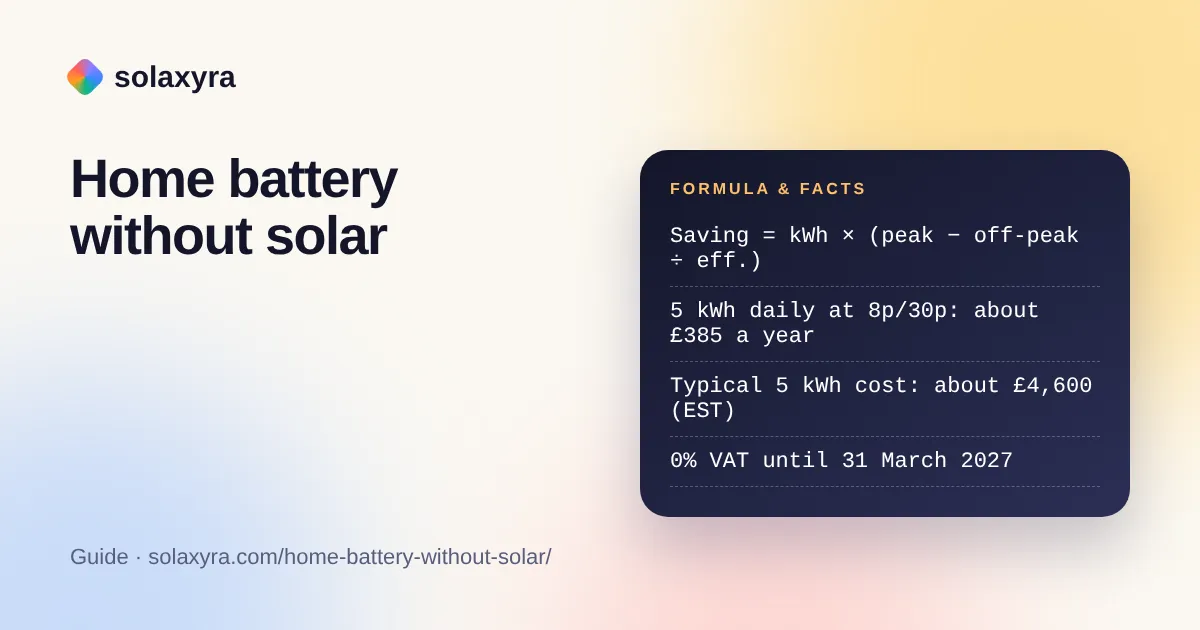
The saving per day equals the kWh you shift multiplied by the peak price, minus the cost of buying that energy at the off-peak price divided by the battery’s round-trip efficiency. In plain words, you pay a little more than one unit of cheap electricity for each unit you get back out, because some energy is lost in charging and discharging.
Daily saving = shifted kWh × (peak price − off-peak price ÷ round-trip efficiency)
The Energy Saving Trust notes that using stored energy is less efficient than using it directly, so you lose some energy along the way. We use 90% round-trip efficiency as an example value in this guide. Check the figure on the datasheet for the battery you are quoted and change it in the formula.
Example: off-peak 8p per kWh and peak 30p per kWh (example rates, not quoted from any supplier), 90% efficiency. Each kWh you take out of the battery cost 8 ÷ 0.9 = 8.89p to put in, so it saves 30 − 8.89 = 21.11p. Shift 5 kWh a day and you save 105.56p a day, or about £385 a year.
How much can a battery without solar save each year?
At example rates, a 5 kWh battery used fully every day saves about £176 to £385 a year and a 10 kWh battery about £352 to £771, depending on the gap between your off-peak and peak prices. The table uses 90% round-trip efficiency and one full cycle a day. The 26.32p rows use the Ofgem price cap electricity rate for October to December 2026 as the price you avoid, which is a fair comparison if you are deciding between a default tariff and a time of use tariff plus battery.
| Example off-peak rate | Example peak rate avoided | Net saving per kWh shifted | 5 kWh used daily, per year | 10 kWh used daily, per year | Payback on £4,600 (5 kWh) |
|---|---|---|---|---|---|
| 8p | 30p | 21.11p | £385.28 | £770.56 | 11.9 years |
| 8p | 26.32p (price cap) | 17.43p | £318.12 | £636.24 | 14.5 years |
| 12p | 30p | 16.67p | £304.17 | £608.33 | 15.1 years |
| 15p | 26.32p (price cap) | 9.65p | £176.17 | £352.35 | 26.1 years |
The Energy Saving Trust gives about £4,600 as a typical price for a 5 kWh system and a lifespan of about 10 to 12 years. Set those two figures side by side and the message is clear: the battery only pays for itself within its life if the price gap is wide and you really do use the stored energy every day. To pay back £4,600 in ten years, a 5 kWh battery needs a net saving of about 25p for every kWh it delivers, which at an 8p off-peak rate means avoiding a peak price of about 34p.
To run the numbers with your own rates, battery size and price, use the home battery savings calculator.
Will you actually use a full battery every day?
Only if your peak-time use is at least as large as the battery, and many homes use less than people expect. Ofgem’s typical domestic consumption value for electricity is 2,500 kWh a year, about 6.8 kWh a day across all 24 hours. If only part of that falls in the peak window, a 10 kWh battery will rarely empty and the second half of it earns nothing.
Example: a two-bedroom flat with no electric heating shifts about 3 kWh a day out of a 5 kWh battery. At the 8p and 30p example rates, the saving is 3 × 21.11p = 63.33p a day, about £231 a year, and the payback on £4,600 stretches to nearly 20 years, beyond the expected battery life.
The picture changes for homes with a heat pump or an electric car, where evening demand is higher. The Energy Saving Trust notes that a battery saves more when it runs a heat pump than when it only stores surplus solar. To estimate how much electricity your appliances use in the evening, add them up in the energy consumption calculator, and use the watts to kWh converter for individual items.
How do you check whether a battery without solar pays for your home?
You can test the case with your own smart meter data before you ask for quotes. Work through these steps:
- Download your half-hourly usage from your supplier’s app or account, ideally covering winter and summer.
- Add up your average daily use in the peak window of the time of use tariff you are considering.
- Choose a battery whose usable capacity is close to that figure, not larger.
- Apply the formula above with the tariff’s off-peak and peak rates and the battery’s round-trip efficiency.
- Multiply by 365 and compare the yearly saving with the installed price and the warranty period.
- Remember to compare against what you would pay on your current tariff, because switching to a time of use tariff can change your costs even without a battery.
Tariff rates change. A battery bought for a particular price gap can lose much of its saving if that gap narrows, so treat a payback period as an estimate, not a promise.
What does a battery-only system cost, and is there VAT?
The Energy Saving Trust says battery systems range from about £1,500 to £10,000, with a 5 kWh system around £4,600 and a typical home system around 10 kWh. On tax, HMRC VAT Notice 708/6 applies the zero rate from 1 February 2024 to 31 March 2027 to installed electrical storage batteries in homes, and it explicitly includes a standalone battery that stores electricity from the grid.
- The zero rate applies only when the battery is supplied and installed, not to a battery bought on its own without installation.
- After 31 March 2027 the guidance says installations revert to the reduced rate of 5%.
- No solar panels are needed to qualify.
Who can install it, and what approvals are needed?
A home battery must be installed by a competent, qualified installer, and the electrical work must meet BS 7671, the UK wiring regulations; this is not a DIY job. The Energy Saving Trust recommends getting at least three quotes from MCS certified installers and says batteries are commonly placed in garages, on external walls or in utility rooms.
Your network operator (DNO) must also be told. According to MCS guidance, for smaller systems the installer can submit a G98 notification within 28 days of installation, while systems above 3.68 kW need a G99 application to the DNO before installation. Your installer is responsible for the paperwork, but ask to see confirmation that it has been done.
If you want the battery to keep lights on during a power cut, ask specifically for backup or emergency power capability. Not every battery-only system provides it, and those that do may only supply selected circuits.
Frequently Asked Questions
Can a home battery work without solar panels?
Yes. A battery can charge from the mains when electricity is cheap, usually overnight on a time of use tariff, and supply your home at peak times. The Energy Saving Trust confirms batteries can be used without solar panels for exactly this purpose.
Do I need a special tariff for a battery without solar?
In practice, yes. Savings come from the gap between off-peak and peak prices, so you need a time of use or smart tariff with a cheap period. On a single flat rate tariff, a battery saves nothing and loses some energy in round-trip losses.
How much does a battery without solar save per year?
It depends on the price gap and how much you shift. At example rates of 8p off-peak and 30p peak with 90% efficiency, a 5 kWh battery used fully every day saves about £385 a year. Using only 3 kWh a day cuts that to about £231.
Is there VAT on a standalone home battery?
Not until 31 March 2027 if it is installed in your home. HMRC Notice 708/6 applies the zero rate to installed batteries, including standalone batteries storing grid electricity. After that date installations revert to the reduced rate of 5%.
What size battery do I need without solar?
Match the usable capacity to the electricity you use in the tariff’s peak window each day, not to your total daily use. A battery larger than your peak-time demand will not empty, and the extra capacity adds cost without adding savings.
How long does a home battery last?
The Energy Saving Trust says home batteries typically last about 10 to 12 years. Compare the payback period you calculate with that lifespan and with the warranty offered, and ask your installer what capacity the warranty guarantees after a set number of years.
Checked October 2026 by the Solaxyra Editorial Team. Sources: Energy Saving Trust: solar panel battery storage, HMRC: VAT Notice 708/6, MCS: notifying DNOs, Ofgem: energy price cap October to December 2026.