This guide sets out the balcony solar Germany rules that apply in 2026 for anyone fitting a Balkonkraftwerk (in law, a Steckersolargerät): the power limits, registration, plug and meter rules, and the rights of tenants and flat owners. It is written in English for residents of Germany, and for UK and Irish readers comparing the German model with the plug-in solar rules that started in Great Britain in August 2026.
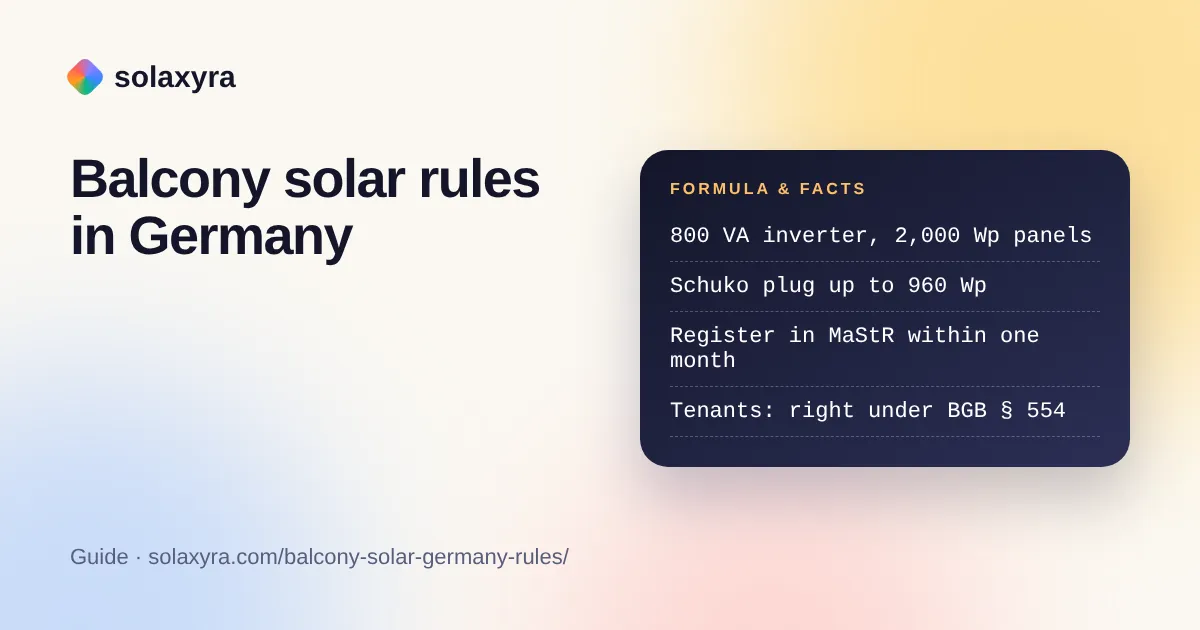
Quick answer: Under the balcony solar Germany rules, a system may have up to 800 VA of inverter output and 2,000 Wp of panels per grid connection. Register it in the Marktstammdatenregister within one month; the grid operator is informed automatically. Kits up to 960 Wp may use a Schuko plug, and tenants have a legal right to request one.
What Are the Power Limits for Balcony Solar in Germany?
A German balcony solar system may feed in no more than 800 VA through its inverter and carry no more than 2,000 W of panels, and both limits are totals for all plug-in devices behind the same grid connection point. The Bundesnetzagentur balcony solar page states the limits and dates the simplified rules from 16 May 2024, when the Solarpaket amendments to the Renewable Energy Sources Act (EEG) took effect.
Because the limit is cumulative, two small kits on one flat count together. Two 400 VA inverters are fine; two 800 VA inverters behind one meter are not. A system above these limits is treated as a normal solar installation, with the full connection process that involves the grid operator and an installer.
The 2,000 W panel allowance exists because panels rarely deliver their rated power on a vertical railing or in winter. Extra panel area keeps the inverter closer to its 800 VA output for more of the day. To see what a given panel size and mounting angle produce, the balcony solar calculator includes Germany as a country option.
How Do You Register a Balkonkraftwerk?
You register a balcony solar system in the Marktstammdatenregister (MaStR), the Bundesnetzagentur’s register of energy installations, within one month of putting it into operation. Since 2024 this single entry replaces a separate notice to the local grid operator, which receives the location and technical data automatically from the register.
The register’s own help guide for balcony systems asks for only a few items about the device: the commissioning date, total module power, inverter power and your meter number, together with your location and a name for the unit. Registration is done online in two stages: create a user account, then register yourself as operator and add the system.
- Create a user account on the Marktstammdatenregister website and confirm your email address.
- Register yourself as the operator of the installation.
- Choose the balcony solar option and enter the commissioning date, module watts, inverter VA and meter number.
- Download and keep the registration confirmation.
Which Plug and Socket Can You Use in Germany?
Since the DIN VDE V 0126-95 product standard was published in December 2025, a balcony solar device with up to 960 Wp of panels may connect through a normal household Schuko socket, while a system with up to 2,000 Wp needs a special energy socket. That is the position set out by VDE FNN, the grid technology forum of the German electrical standards body.
| Panel power (Wp) | Inverter output | Connection allowed | Who connects it |
|---|---|---|---|
| Up to 960 Wp | Up to 800 VA | Household Schuko socket, with a device built to DIN VDE V 0126-95 (protected plug or internal disconnection) | The user, following the manufacturer’s instructions |
| 961 to 2,000 Wp | Up to 800 VA | Special energy socket (often called a Wieland socket) or fixed connection | The socket and circuit work is for a qualified electrician |
| Above 2,000 Wp or above 800 VA | Any | Not a balcony solar device; normal PV connection process | Installer and grid operator |
VDE FNN recommends the energy socket as the safe option whenever the conditions for a household socket cannot be met, and says an electrician should check that the existing circuit is adequately rated and protected. Never use a multi-way adaptor or join devices together to get round the limits, and do not alter sockets or wiring yourself.
Do You Need a New Electricity Meter?
Yes, a bidirectional meter is required, but you do not have to wait for it: the Bundesnetzagentur says an older meter that runs backwards may be tolerated temporarily until the replacement is made. Under § 10a EEG the meter operator must replace it without undue delay, and you do not need to ask separately because registration in the MaStR triggers the process.
Electricity you feed into the grid is unpaid by default. The Bundesnetzagentur assigns balcony solar to free feed-in (unentgeltliche Abnahme), so the value of a system comes from the power you use at home while it generates. The self-consumption calculator shows how daytime habits change that share.
Can Tenants and Flat Owners Install Balcony Solar in Germany?
Yes, since October 2024 tenants and condominium owners have a legal claim to install a balcony solar device, because plug-in solar was added to the privileged structural changes in § 554 of the Civil Code (BGB) for tenants and § 20 of the Condominium Act (WEG) for owners. The Bundestag voted the change through on 4 July 2024.
The claim is not unconditional. A landlord may refuse where the measure cannot reasonably be expected of them, and landlords and owners’ associations keep a say over how the system is installed, for example the position and fixing on the facade. Ask in writing, describe the device and its mounting, and keep the reply.
How Do Germany’s Rules Compare With the UK?
The two systems share the 800 W output cap and the 2,000 W panel allowance, but the UK adds stricter rules on devices per home, extension leads and mounting surfaces. The UK rules took effect on 27 August 2026 under SI 2026/848 and the government’s interim product specification, which names the German product standard DIN VDE V 0126-95 as its main technical reference.
| Rule | Germany | Great Britain |
|---|---|---|
| In force since | 16 May 2024 (EEG Solarpaket limits) | 27 August 2026 |
| Inverter output | 800 VA | 800 VA |
| Panel power | 2,000 Wp (960 Wp on a Schuko socket) | 2,000 W (professional assessment advised above 960 W) |
| Number of devices | Several allowed if the totals stay within the limits per connection point | One device per household |
| Plug | Schuko or special energy socket | Moulded BS 1363 plug with a fuse of 5 A or less |
| Registration | Marktstammdatenregister within one month | Online registration; householder notifies the network operator |
| Tenants | Legal claim under BGB § 554 | Landlord permission needed |
| Feed-in payment | None by default (free feed-in) | Normally none (MCS needed for the Smart Export Guarantee) |
| Battery | Outside the simple balcony rules | Not allowed with a plug-in device |
The UK government’s announcement noted that around half a million new devices were plugged in in Germany last year, and described the UK safety specification as more stringent than Germany’s. For the full British position, see our guide to the plug-in solar rules in the UK, and for output and payback figures with UK or German yields, use the plug-in solar calculator.
What About Batteries?
A balcony solar device with built-in battery storage falls outside the simple rules described here: DIN VDE V 0126-95 covers devices without storage, and the consumer advice centres (Verbraucherzentrale) say kits with integrated storage still need installation by a qualified electrician and notification to the grid operator. Treat any home battery as fixed electrical equipment and have it fitted and checked by a qualified electrician.
Frequently Asked Questions
Is 800 W the maximum for balcony solar in Germany?
Yes. The inverter may feed in no more than 800 VA, and all plug-in devices behind one grid connection point count together. The panels may total up to 2,000 Wp, so a kit can produce close to 800 VA for more hours of the day.
Do I have to tell the grid operator about my Balkonkraftwerk?
Not separately. Since 2024 registering the system in the Marktstammdatenregister within one month of commissioning is enough, and the Bundesnetzagentur says the grid operator receives the location and technical data automatically.
Can I plug a balcony solar system into a normal socket in Germany?
Yes, for devices with up to 960 Wp of panels built to the DIN VDE V 0126-95 product standard from December 2025. Systems with up to 2,000 Wp need a special energy socket, and that socket and circuit work should be done by a qualified electrician.
Can my landlord stop me installing balcony solar in Germany?
Only in limited cases. Since October 2024 § 554 BGB gives tenants a claim to approval for plug-in solar, but a landlord may refuse where it cannot reasonably be expected of them and can set conditions on how the system is installed.
Will an old electricity meter be a problem?
No. The Bundesnetzagentur says an older meter that runs backwards may be tolerated temporarily. After you register, the meter operator must fit a bidirectional meter without undue delay, and you do not need to request it separately.
Checked October 2026 by the Solaxyra Editorial Team. Sources: Bundesnetzagentur: Balkon-Solaranlagen, Marktstammdatenregister registration guide for balcony systems, VDE FNN: plug-in PV systems, VDE FNN: what is now possible, Deutscher Bundestag, 4 July 2024, Verbraucherzentrale: laws and standards for plug-in solar, GOV.UK plug-in solar announcement, DESNZ interim product specification.