This guide explains how tenants in England, Scotland and Wales can use plug-in solar legally: whose permission you need, where you can and cannot fit a kit, how to ask your landlord, and what happens when you move. Plug in solar for renters became a realistic option on 27 August 2026, when 800 W kits that plug into a normal socket became legal in Great Britain.
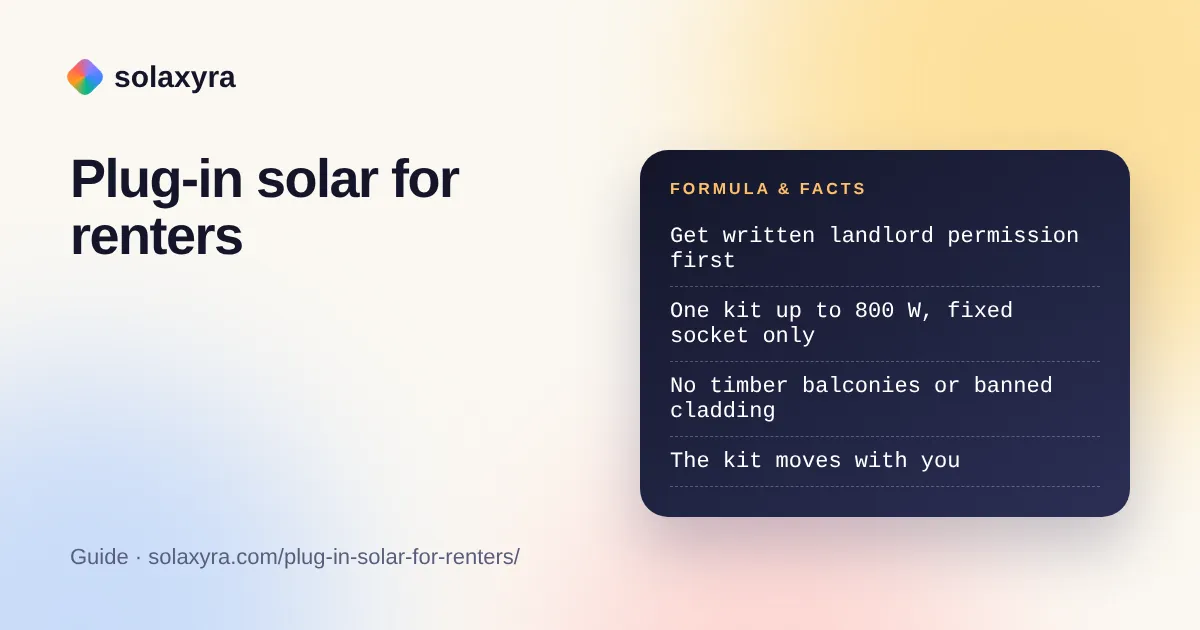
Quick answer: Plug in solar for renters is allowed in Great Britain, but you must get permission from your landlord, freeholder or managing agent first. The kit must be up to 800 W, plug straight into a fixed socket, be registered and avoid banned spots such as timber balconies. You can take it with you when you move.
Can Renters Use Plug-In Solar in the UK?
Yes, renters in Great Britain can use one plug-in solar device of up to 800 W, provided they have permission from whoever is responsible for the building. In its July 2026 consultation response, the government said renters, leaseholders and residents in managed buildings should obtain any permissions that may be required before installing a device, and its interim product specification makes the user responsible for getting consent from the property owner, landlord, freeholder, managing agent or relevant authority.
The same response recognised why the change matters to tenants: people in rented homes, flats and properties without suitable roof space usually cannot fit rooftop solar because they do not control the roof. It also recorded concerns from respondents that landlord opposition and uncertainty about insurance could hold renters back.
Plug-in solar is not currently legal in Northern Ireland, so tenants there cannot use it yet.
Do You Need Your Landlord’s Permission?
Yes, you should get written permission before you buy, because the government guidance, the product specification and the Energy Saving Trust all say to get consent from whoever is responsible for the building. A kit fixed to a wall, railing, fence or flat roof is attached to property you do not own, and your tenancy agreement may also restrict alterations, so a written yes protects you if there is a dispute later or when your deposit is returned.
Planning can also apply. The Energy Saving Trust checklist tells you to check the Planning Portal in England and Wales or ePlanning Scotland, and to ask the local authority if the building is listed or in a conservation area. Your landlord may already know the answer.
How Do You Ask Your Landlord for Permission?
A short written request that answers the landlord’s likely worries in advance gets the quickest yes. Include these points:
- The exact make and model, and confirmation that it is listed on the ENA type test register required for plug-in devices.
- Where it will go and how it is fixed, using the manufacturer’s frame. Mention that the rules require any fixing to be reversible and non-permanent, and that ropes, cable ties, tape and straps are not allowed as the only fixing.
- Which socket it will use: a fixed socket, with no extension lead or adaptor, on a circuit with RCD or RCBO protection.
- That you will register the device as required and that only one device will be used.
- Who pays for any electrical check and that you will remove the kit and make good any fixing holes when you leave.
- That you will tell your contents insurer, and ask the landlord to check whether the buildings insurer needs to know.
Keep the reply with your tenancy papers. If the landlord refuses or attaches conditions, ask what would change their mind; a freestanding ground frame in a garden involves no fixings to the building at all.
Which Rented Homes Suit Plug-In Solar?
Houses with a garden or yard suit plug-in solar best, while some flats are ruled out by the mounting rules regardless of what the landlord says. The table summarises the main situations, based on the government product specification and Energy Saving Trust guidance.
| Rented home | Usually possible? | What to check |
|---|---|---|
| House with a garden or yard | Yes, with permission | A freestanding frame and a suitable socket; an outdoor socket must be fitted by a qualified electrician and be at least IP65 |
| Flat with a masonry or metal balcony | Possibly | Landlord and freeholder consent, the building’s fire safety rules and a manufacturer mount suited to your railing |
| Flat with a timber balcony | No | The specification bans installation on timber balconies |
| Building with ACM, MCM, HPL or timber cladding | No | The specification bans installation on these cladding systems |
| Building under external wall or building safety remediation | No | Excluded by the specification until restrictions are lifted |
| Shared house where another tenant already has a kit | No | Only one plug-in device is allowed per household |
| Home with an old fuse board and no RCD or RCBO | Only after an electrical check | A registered electrician must check and, where needed, upgrade the installation to BS 7671; this needs the landlord’s agreement |
Fire safety in flats was raised by many consultation respondents, who said balconies and walls of multi-occupancy and high-rise buildings carry greater risk. Expect landlords and managing agents of blocks to be cautious, and do not install on a balcony without clear written consent from the building owner.
What Electrical Rules Apply in a Rented Home?
The kit must plug directly into a fixed BS 1363 socket on a circuit protected by an RCD or RCBO, and never into an extension lead or multi-way adaptor. The Energy Saving Trust adds that the socket should not also control lighting or a hardwired appliance such as a boiler or cooker.
In a rented home the electrical installation belongs to the landlord, so any work on it, including a new outdoor socket or an upgrade from an old fuse board, needs their agreement and must be done by a registered electrician to BS 7671. Do not change sockets, fuses or wiring yourself. The specification also requires a label to be fixed at or near the consumer unit showing that a plug-in solar device is present, which helps anyone working on the electrics later.
You cannot add a battery. The legal definition of a plug-in microgenerator excludes devices that store energy, and every kit must warn that it is not for use with a battery storage system. Portable power stations charged from their own panels are a separate product and are not connected to your home wiring.
Is Plug-In Solar Worth It If You Might Move?
Yes, often, because the kit moves with you: the Energy Saving Trust notes that plug-in panels are portable and can be taken when you move home. The money you save while you live in one place is a bonus on top of a kit you still own.
The table shows savings over the time left in a tenancy, using the Energy Saving Trust estimate of about 700 kWh a year and the Ofgem price cap rate of 26.32p per kWh for 1 October to 31 December 2026. The share used at home is an example; change it to match your daytime habits.
| Share of output used at home (example) | Yearly saving | Saving over 1 year | Saving over 3 years | Saving over 5 years |
|---|---|---|---|---|
| 40% (out during the day) | £74 | £74 | £221 | £368 |
| 50% | £92 | £92 | £276 | £461 |
| 60% (home most of the day) | £111 | £111 | £332 | £553 |
These figures assume the same rate each year; the cap changes every quarter, and the 26.32p rate excludes VAT only until 31 March 2027. Your output will also change at a new address with a different direction or more shade. To test a specific spot before you buy, use the plug-in solar calculator, and if your only space is a balcony the balcony solar output calculator compares railing and angled mounts.
What Should Renters Do When They Move Out?
Unplug the kit, remove it and its fixings, and tell the network operator it has been disconnected, since the rules require notification of both connection and disconnection.
- Switch off and unplug the device from the socket before dismantling the panels.
- Remove the mounting frame and make good any marks, as agreed in your permission letter.
- Update the plug-in solar registration to record the disconnection.
- Leave the consumer unit label in place only if the landlord asks; otherwise remove it so the next occupant is not misled.
- At your new home, get fresh permission, check the socket and circuit, and register the device at the new address.
Frequently Asked Questions
Can my landlord refuse plug-in solar?
Yes. The government says renters should obtain any permissions that may be required before installing, and landlords, freeholders and managing agents can refuse or set conditions. A freestanding ground frame with no fixings, and an offer to pay for any electrical check, can make agreement easier.
Can I use plug-in solar in a rented flat?
Sometimes. You need consent from the landlord and often the freeholder or managing agent, and the kit must not go on a timber balcony, on ACM, MCM, HPL or timber cladding, or on a building under safety remediation. A masonry or metal balcony with a suitable mount may be possible.
Can I take plug-in solar panels with me when I move?
Yes. The Energy Saving Trust says plug-in panels are portable and can be taken when you move. Record the disconnection on the registration, remove all fixings, then get permission and register the device again at your new home before plugging it in.
Who pays for electrical work needed for plug-in solar in a rented home?
That is for you and your landlord to agree in writing. Any work such as a new outdoor socket or replacing an old fuse board must be done by a registered electrician to BS 7671, and the landlord must agree because the installation belongs to them.
Can renters add a battery to plug-in solar?
No. UK law defines a plug-in microgenerator as a device that does not store energy, and the government specification says it must not be connected to or used with a battery storage system. This applies to tenants and owners alike.
Checked October 2026 by the Solaxyra Editorial Team. Sources: DESNZ plug-in solar government response, July 2026, DESNZ Plug-in Solar Device Interim Product Specification, SI 2026/848, Energy Saving Trust: plug-in solar panels, Energy Saving Trust: plug-in solar checklist, Ofgem price cap October to December 2026.