Size, charge and run batteries with confidence. These tools cover home solar storage, off-grid battery banks and simple conversions between amp-hours and kilowatt-hours.
Most popular
Battery maths depends on three things people often mix up: nominal capacity, usable capacity after depth of discharge, and the energy lost in charging, discharging and the inverter. Every calculator here shows those steps separately so you can see where the energy goes.
Home batteries in the UK should be installed by a qualified installer, and fixed electrical work must meet BS 7671. Treat every result as a planning estimate and check the manufacturer datasheet for the real limits of your battery.
All battery & storage calculators
More battery & storage calculators
Guides on this topic
-
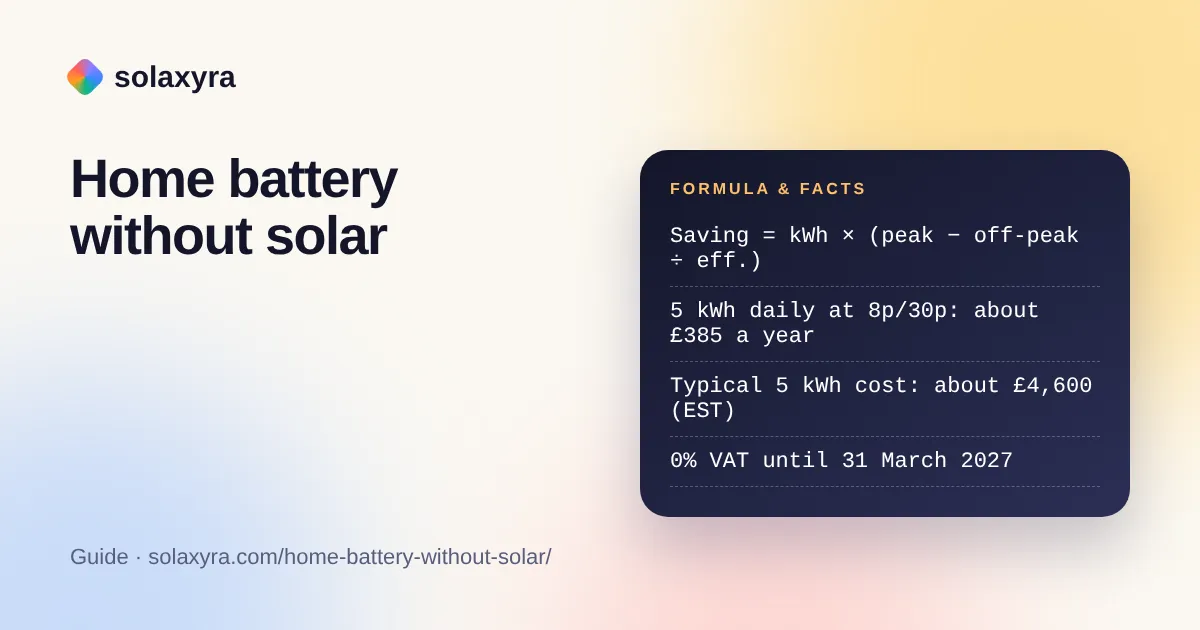
Home Battery Without Solar: Does It Pay in the UK?
How a grid-charged battery saves money, real savings after losses, VAT and payback checks.
Frequently Asked Questions
What size battery do I need for solar?
Many homes size the battery to cover evening and overnight use, then adjust for depth of discharge and efficiency. If you use 6 kWh after sunset and your battery delivers 90% of its rating, a nominal size of about 7 kWh is a reasonable starting point.
How do I convert Ah to kWh?
Multiply amp-hours by the nominal voltage and divide by 1,000. A 100 Ah battery at 12.8 V stores 1.28 kWh. The Ah to kWh calculator also handles series and parallel banks and shows usable energy.
How long will a battery run my appliance?
Divide the usable watt-hours by the load in watts, after allowing for inverter losses. A battery with 1,000 usable Wh running a 100 W load through a 90% efficient inverter lasts about 9 hours.
Checked October 2026 by the Solaxyra Editorial Team. Read how we build and check our tools in our editorial policy.