Guidance only. Check the controller’s own limits for PV voltage, PV short-circuit current and maximum PV power. Fit fuses or breakers and cables sized for each circuit. Mains-connected and home battery systems must be installed or checked by a qualified electrician (UK: BS 7671; elsewhere the local rules).
Formula and breakdown
n/a
This MPPT charge controller calculator sizes a solar charge controller for 12 V, 24 V and 48 V battery systems in vans, boats, cabins and off-grid homes across the UK and Europe. It works out the charge current with a safety margin, suggests the next common controller size, and checks the two limits that destroy or cripple controllers: cold-weather panel voltage and too little voltage on hot days.
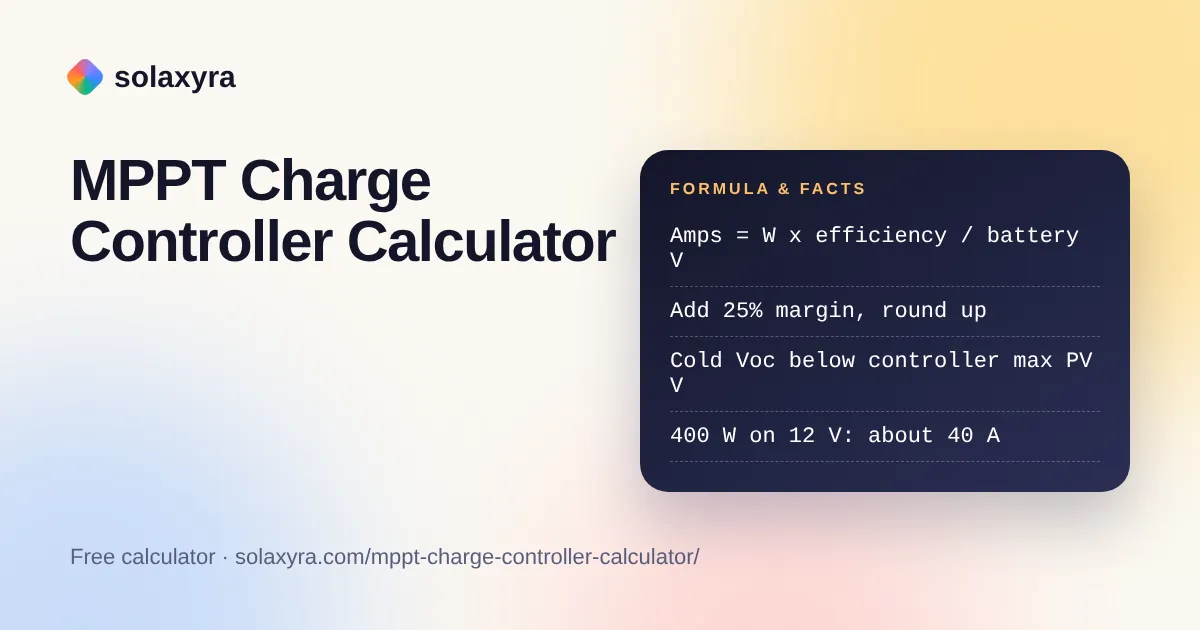
Quick answer: An MPPT charge controller calculator divides solar array watts, after controller losses, by battery voltage and adds about 25% margin. A 400 W array on 12 V needs roughly 40 A, or 20 A on 24 V. The string's cold open-circuit voltage must also stay below the controller's maximum PV voltage.
What Is an MPPT Charge Controller Calculator?
An MPPT charge controller calculator is a tool that matches a solar array to a maximum power point tracking controller by current, voltage and power so the battery charges fully without overloading the controller. An MPPT controller takes the higher voltage from the panels and converts it down to the battery's charging voltage, which raises the current flowing into the battery. The technique, explained in the overview of maximum power point tracking, continually adjusts the load on the panels so they run at the voltage where they give the most power.
The formula in plain words: charge current equals array power, times controller efficiency, divided by battery voltage. Add a safety margin, usually 25%, and round up to the next size made. Separately, multiply each panel's open-circuit voltage by the number in series and correct it for the coldest temperature; that figure must be below the controller's maximum PV input voltage. Finally, the hot-day working voltage of the string should sit comfortably above the battery charging voltage so the controller can start and keep charging.
How Do You Use the MPPT Charge Controller Calculator?
- Pick your battery bank voltage: 12 V, 24 V or 48 V.
- Enter the power of one panel and how many panels are in series and in parallel.
- Copy Voc, Vmp, Isc and the temperature coefficients from the panel datasheet.
- Enter the coldest likely temperature at your site and a hot cell temperature for summer.
- Enter the controller efficiency, your current margin, the controller's maximum PV voltage, and the battery charge voltage from the battery maker.
- Read the minimum charge current, the next common size and the voltage checks. Any failed check appears in the warning box.
What Size MPPT Controller Do I Need for a 400 W Solar Panel Array?
A 400 W array needs about a 40 A MPPT controller on a 12 V battery, 20 A on 24 V or 10 A on 48 V, using 95% efficiency and a 25% margin. This is the conservative method, because it divides by nominal battery voltage rather than the higher charging voltage. Manufacturers also publish a nominal PV power for each model. For example, the Victron SmartSolar MPPT 100/30 specification lists 30 A charge current and 440 W nominal PV power at 12 V, or 880 W at 24 V, so a 400 W array is within that unit's rating even though it falls short of the 25% rule. When the two methods disagree, the controller maker's own figures take priority. If you are still sizing the array, start with our off grid solar calculator.
Why Does the Controller's Maximum PV Voltage Matter So Much?
Exceeding the controller's maximum PV voltage, even briefly on a frosty morning, can permanently damage it, so this is a hard limit rather than a guideline. Panel open-circuit voltage rises as the cells get colder, by the Voc temperature coefficient for every degree below 25 °C. Two 24.3 V panels in series give 48.6 V on the datasheet, but about 53.5 V at -10 °C with a -0.29 %/°C coefficient. Four in series would reach 107 V and overload a 100 V controller. The same cold-voltage maths applies to grid inverters, covered in more depth by the solar string size calculator.
How Much Higher Than the Battery Must the Panel Voltage Be?
Victron states that PV voltage must exceed battery voltage plus 5 V for its MPPT 100/30 and 100/50 controllers to start, and battery voltage plus 1 V to keep running. For a 12 V battery charging at 14.4 V, that means about 19.4 V at start-up. Hot panels lose voltage, so a single 20 V class panel can struggle on a 12 V system in summer heat, and a single panel cannot charge a 24 V battery at all. Two or more panels in series give the controller more headroom and reduce cable current. Lower cable current also reduces losses, which you can check with the voltage drop calculator.
Can You Connect More Solar Power Than the Controller Rating?
Only if the controller maker allows it, and never beyond the input limits. A controller cannot deliver more than its rated charge current, so any array power above that is simply not harvested at midday, though a larger array can help in poor light. What must never be exceeded are the maximum PV voltage and the maximum PV short-circuit current; the Victron 100/30 specification, for example, gives 100 V and 35 A for these. Check your own controller's datasheet before adding panels, because limits differ between makers.
MPPT Controller Size by Array Power
Minimum charge current with 95% efficiency and a 25% margin, rounded to one decimal place. Choose the next size up that the maker offers.
| Array power | 12 V battery | 24 V battery | 48 V battery |
|---|---|---|---|
| 100 W | 9.9 A | 4.9 A | 2.5 A |
| 200 W | 19.8 A | 9.9 A | 4.9 A |
| 300 W | 29.7 A | 14.8 A | 7.4 A |
| 400 W | 39.6 A | 19.8 A | 9.9 A |
| 600 W | 59.4 A | 29.7 A | 14.8 A |
| 800 W | 79.2 A | 39.6 A | 19.8 A |
| 1,000 W | 99.0 A | 49.5 A | 24.7 A |
| 2,000 W | 197.9 A | 99.0 A | 49.5 A |
The table shows why larger systems move to 24 V or 48 V: the same 2,000 W needs a quarter of the current at 48 V that it needs at 12 V, which means smaller controllers, thinner cables and smaller fuses.
Worked Example: Emma's Campervan in Galway
Emma in Galway is fitting two 200 W panels to her campervan with a 12 V lithium battery that charges at 14.4 V. Each panel has Voc 24.3 V, Vmp 20.4 V, Isc 10.5 A and a Voc coefficient of -0.29 %/°C. She wires them in series and designs for -10 °C in winter and 65 °C cells in summer.
- Array power: 2 x 200 W = 400 W.
- Charge current: 400 x 0.95 / 12 = 31.7 A, or 39.6 A with a 25% margin, so the conservative choice is a 40 A controller.
- Cold Voc: 2 x 24.3 x (1 + 0.0029 x 35) = 53.5 V, which suits a 100 V controller with plenty of headroom.
- Hot Vmp: 2 x 20.4 x (1 − 0.0035 x 40) = 35.1 V, well above the 19.4 V start-up guide.
Emma compares this with the datasheet of a 30 A, 100 V controller rated for 440 W of PV at 12 V and sees it would also work: 30 A at 14.4 V is about 430 W into the battery, more than her 400 W array can deliver after losses. She chooses the 30 A unit, adds a fuse on the battery cable sized to the maker's instructions, and keeps the series wiring because it halves the roof cable current compared with parallel.
Frequently Asked Questions
How do I calculate the amps for a solar charge controller?
Divide the total array watts by the battery voltage, multiply by the controller efficiency, then add a safety margin of around 25%. For 600 W on a 24 V battery at 95% efficiency, that is 600 x 0.95 / 24 = 23.8 A, or about 30 A with margin.
Is MPPT better than PWM?
An MPPT controller converts surplus panel voltage into extra charging current, so it can harvest more energy when panel voltage is well above battery voltage, in cold weather and with panels in series. A simpler PWM controller suits small systems where panel and battery voltages are already closely matched.
What does 100/30 or 150/35 mean on an MPPT controller?
The first number is the maximum PV open-circuit voltage the controller accepts, and the second is the maximum charge current into the battery. A 100/30 model accepts up to 100 V from the panels and delivers up to 30 A to the battery, as shown on the Victron specification.
Should I wire my panels in series or parallel for an MPPT controller?
Series wiring raises voltage and lowers current, which reduces cable losses and gives the controller more headroom on hot days. Parallel wiring keeps voltage low, which helps with partial shading on separate panels and with low voltage controllers. Always keep cold series voltage under the controller limit.
Can I use a bigger MPPT controller than I need?
Yes. A controller rated for more current than the array can supply simply runs below its limit, and it leaves room to add panels later. The only cost is price and size. The voltage limit still matters, so check cold Voc against the larger model's maximum PV voltage.
Do I need an electrician to install a solar charge controller?
Low voltage van and boat systems are often fitted by owners, but they still need correct fuses, cable sizes and isolation because batteries can deliver very high fault currents. Any system connected to home wiring or mains must be installed or checked by a qualified electrician; in the UK it must meet BS 7671.
Checked October 2026 by the Solaxyra Editorial Team. Sources: Victron Energy SmartSolar MPPT 100/30 and 100/50 specifications, Wikipedia: Maximum power point tracking.