Sizing guide only. Inverters must also handle start-up surges of motors and compressors. Fixed wiring, batteries and grid connection must be installed or checked by a qualified electrician (UK: to BS 7671).
Formula and breakdown
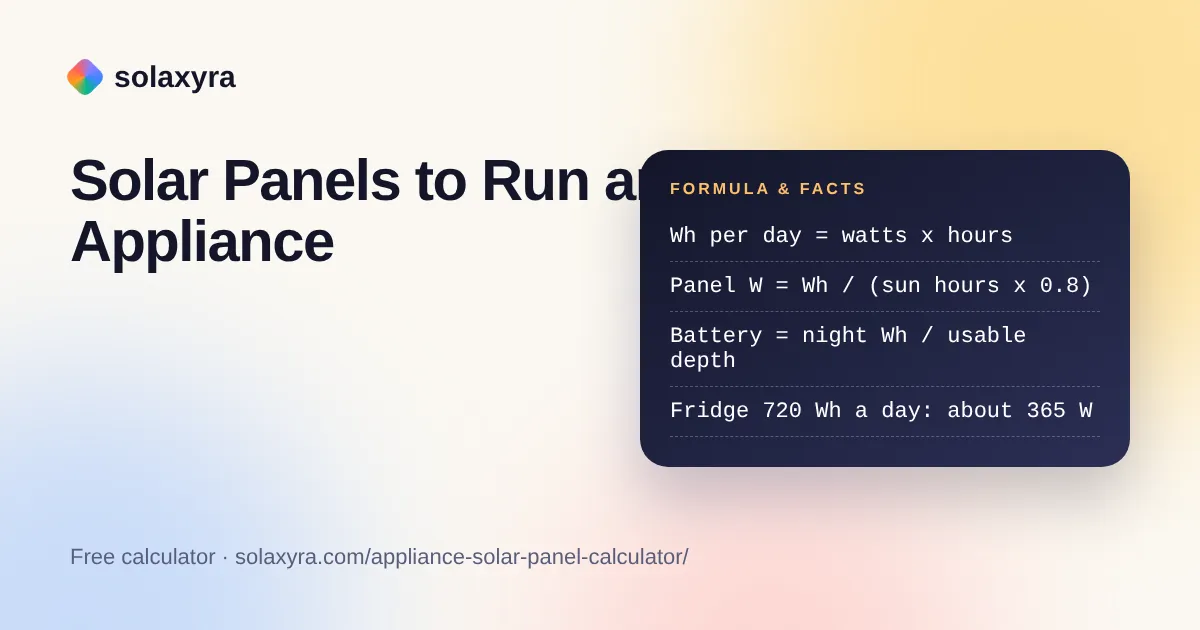
Energy per day (Wh) = watts x hours x quantity
Solar needed = daytime Wh + after-dark Wh / battery efficiency
Panel watts = solar needed / (peak sun hours x (1 − losses))
Battery (nominal) = after-dark Wh / usable depth
This calculator shows how many solar panels to run an appliance, from a fridge or TV to a kettle or heater, for homes, sheds, garden offices and off-grid setups in the UK, Europe and beyond. Choose an appliance, adjust its watts and hours, set your sun hours and panel size, and it returns the daily energy, panel watts, number of panels and the battery needed for after-dark use.
Quick answer: To work out how many solar panels to run an appliance, multiply its watts by hours of use to get daily watt-hours, then divide by peak sun hours and allow for losses. A 30 W average fridge-freezer uses 720 Wh a day, needing about 365 W of panels at 2.6 sun hours and 20% losses.
What Is an Appliance Solar Panel Calculator?
An appliance solar panel calculator is a tool that sizes the solar panels, and if needed the battery, required to supply one appliance’s daily energy. The formula in plain words: watts multiplied by hours of use and quantity gives watt-hours per day; the part used after dark is divided by battery efficiency, because storage loses some energy; the total is then divided by peak sun hours and by one minus system losses to give the panel watts; dividing by one panel’s rating gives the panel count.
Every wattage in the appliance list is an editable typical value, not a measured figure for your model. The rating plate, manual or energy label gives the real number. For appliances that cycle on and off, such as fridges and freezers, use an average draw: the energy label’s kWh per year divided by 365 and by 24, times 1,000, gives average watts.
How Do You Use the Appliance Solar Panel Calculator?
- Pick an appliance from the list. Typical watts, hours and an after-dark share load automatically.
- Replace the watts with the figure from your appliance’s rating plate or label, and adjust hours per day and quantity.
- Set the share of use that happens after dark. That share needs a battery.
- Enter peak sun hours for your site. Use a yearly average for grid-connected panels, or a winter value if the appliance must run all year off-grid.
- Check system losses, panel rating, battery efficiency, usable depth and battery voltage.
- Read the panel count, panel watts, battery size in Wh and Ah, and the yearly grid value of the energy.
How Many Solar Panels to Run an Appliance at Home?
Most small household appliances need one 400 W panel or less on a yearly average, while heating appliances need several. Working out how many solar panels to run an appliance always starts with its daily watt-hours, not its wattage alone. The table below uses the calculator’s example settings: 2.6 peak sun hours, 20% system losses, 400 W panels, 90% battery efficiency and 80% usable battery depth.
| Appliance (typical, editable) | Watts | Hours a day | Wh a day | Panel watts needed | 400 W panels | Battery for after-dark share |
|---|---|---|---|---|---|---|
| Fridge-freezer (average draw) | 30 | 24 | 720 | 365 W | 1 | 450 Wh (50% at night) |
| Chest freezer (average draw) | 20 | 24 | 480 | 244 W | 1 | 300 Wh (50%) |
| LED TV | 80 | 4 | 320 | 167 W | 1 | 300 Wh (75%) |
| Wi-Fi router | 10 | 24 | 240 | 122 W | 1 | 150 Wh (50%) |
| Laptop | 50 | 6 | 300 | 149 W | 1 | 112 Wh (30%) |
| Dehumidifier | 200 | 6 | 1,200 | 609 W | 2 | 750 Wh (50%) |
| Dishwasher (daytime) | 1,000 | 1 | 1,000 | 481 W | 2 | None |
| Electric fan heater | 2,000 | 3 | 6,000 | 3,077 W | 8 | 4,500 Wh (60%) |
All wattages and hours are typical example values. Enter your own appliance data in the calculator.
What Are Peak Sun Hours and Which Value Should You Use?
Peak sun hours are your site’s daily solar energy expressed as the number of hours of full-strength sunshine at 1,000 W per square metre, so a yearly yield of 950 kWh per kWp works out at about 2.6 peak sun hours a day. That example default suits a grid-connected system where summer surplus can balance winter shortfall. An off-grid appliance that must run every day of the year needs sizing for the darkest month, when the figure is much lower than the yearly average. The European Commission’s PVGIS service gives monthly solar data for almost any location free of charge. For a full cabin or van system with several loads, the off-grid solar calculator handles autonomy days and charge controllers too.
Do You Need a Battery to Run an Appliance on Solar?
You need a battery only for the part of the appliance’s use that happens after dark or in heavy cloud. A fridge runs day and night, so roughly half its energy has to come from storage; a dishwasher run at lunchtime needs none. The calculator sizes the battery as after-dark watt-hours divided by usable depth, so a 360 Wh night load with 80% usable depth needs a 450 Wh battery, which is about 38 Ah at 12 V. Energy stored in a battery also loses some on the way in and out, which is why the after-dark share is divided by the battery efficiency before sizing the panels. For whole-home storage sizing, use the solar battery size calculator.
Can Solar Panels Run High-Power Appliances Like Kettles and Heaters?
Yes, but only with a large array, a high-power inverter and usually a battery, because a 3,000 W kettle or 2,000 W heater draws its full power the whole time it is on. When you work out how many solar panels to run an appliance of this kind, remember that panel count follows daily energy, so a kettle used for 12 minutes a day needs fewer panels than its wattage suggests. The inverter, however, must supply the full wattage at once, and motor-driven appliances such as fridges and pumps also take a short start-up surge above their running power. Check both figures in the manufacturer’s data before buying an inverter or power station.
Safety matters as power rises. Any fixed wiring, battery installation or connection to a home’s electrics must be carried out or checked by a qualified electrician; in the UK that means a registered electrician working to BS 7671, and elsewhere your national wiring rules apply.
Worked Example: Tom Powers a Garden Office in Cardiff
Tom in Cardiff wants solar to run a laptop, a router and four LED bulbs in his garden office. He enters each appliance separately to see how many solar panels to run an appliance of each type, then adds up the results.
- Laptop: 50 W x 7 hours = 350 Wh a day, all in daylight.
- Router: 10 W x 10 hours = 100 Wh a day, 20% after dark.
- LED bulbs: 4 x 8 W x 3 hours = 96 Wh a day, 70% after dark.
- Total: 546 Wh a day, of which 87 Wh is after dark (20 Wh router plus 67 Wh lights).
- Solar needed: 459 Wh daytime plus 87 / 0.9 = 97 Wh for the battery, so 556 Wh a day.
- Panel watts at 2.6 sun hours and 20% losses: 556 / (2.6 x 0.8) = 267 W, so one 400 W panel.
- Battery: 87 / 0.8 = 109 Wh, about 9 Ah at 12 V.
Because Tom wants the office to work in December too, he reruns the numbers with a lower winter sun-hours figure from PVGIS and finds he needs a second panel and a larger battery for the darkest weeks.
Can a Plug-in Solar Kit Run Household Appliances?
A plug-in kit can cover small daytime loads such as a fridge, router and TV, because UK kits deliver up to 800 W. The government’s plug-in solar announcement confirms these kits became legal on 27 August 2026 and says one can run a typical fridge, TV, router, laptop, phone charger and games console together when the sun is shining. Kits like this do not power a heater or kettle on their own, and they feed the home circuit rather than a single appliance. The plug-in solar calculator estimates a kit’s yearly output and savings, and the energy consumption calculator totals all your appliances at once.
Frequently Asked Questions
How many solar panels does it take to run a fridge?
A fridge-freezer averaging 30 W uses about 720 Wh a day. At 2.6 peak sun hours with 20% losses it needs about 365 W of panels, so one 400 W panel, plus a battery of around 450 Wh if half its use falls after dark.
Can one solar panel run a TV?
Often yes on a yearly average. An 80 W LED TV watched for 4 hours uses 320 Wh a day, which needs about 167 W of panels at 2.6 sun hours. Evening viewing needs a battery, because panels produce nothing after dark.
Can solar panels run a kettle or electric heater?
Only with a large system. A kettle draws around 3,000 W while it boils, so the inverter and battery must be able to deliver that power continuously. A 2,000 W heater running 3 hours uses 6 kWh a day, needing about eight 400 W panels.
What are peak sun hours?
Peak sun hours are the daily solar energy at a site expressed as hours of full 1,000 W per square metre sunshine. A yearly yield of 950 kWh per kWp equals about 2.6 peak sun hours a day on average. Winter values are much lower.
Do I need a battery to run an appliance on solar?
Only for use after dark or in poor weather. Daytime loads can run straight from panels through an inverter. For night use, size the battery as night-time watt-hours divided by its usable depth, so 360 Wh at 80% needs a 450 Wh battery.
Can a plug-in solar kit run my appliances?
A UK plug-in kit, legal from 27 August 2026 and limited to 800 W of output, can cover small daytime loads. The government says it can run a fridge, TV, router, laptop, phone charger and games console at once in sunshine.
Checked October 2026 by the Solaxyra Editorial Team. Sources: GOV.UK plug-in solar announcement, Ofgem energy price cap October to December 2026, European Commission JRC PVGIS, Energy Saving Trust solar panels.