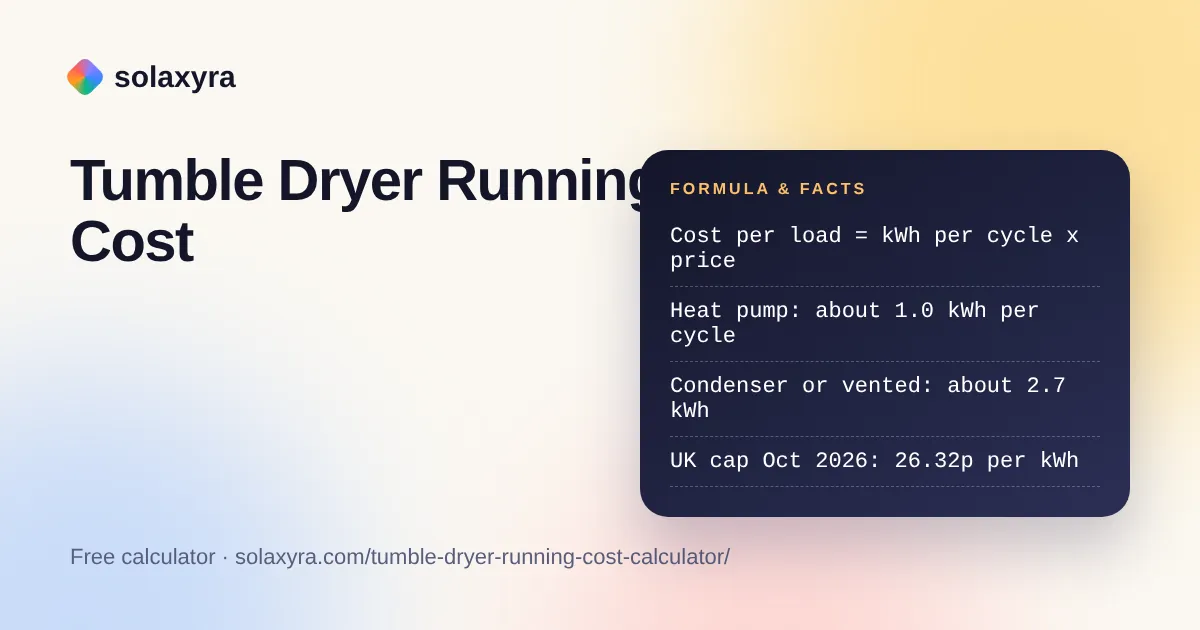
Typical values: 1.0 kWh per cycle for heat pump dryers and 2.7 kWh for vented and condenser dryers (EU averages for 2020). Large drums on full cotton loads can use more.
Formula and breakdown
Cost per load = kWh per cycle x unit price
Yearly cost = cost per load x loads per week x 52
Label conversion: kWh per 100 cycles / 100, or old label kWh per year / 160
This tumble dryer running cost calculator works out what each load, week and year of drying costs for UK, Irish and European households, using your dryer type, its energy label figure, how often you dry and your electricity tariff. It also shows how much a heat pump dryer would save compared with an older condenser or vented model.
Quick answer: A tumble dryer running cost calculator multiplies the dryer’s kWh per cycle by your unit price. At the UK cap of 26.32p per kWh (October to December 2026), a heat pump dryer using about 1.0 kWh costs roughly 26p a load, while a condenser or vented dryer using about 2.7 kWh costs roughly 71p.
What Is a Tumble Dryer Running Cost Calculator?
A tumble dryer running cost calculator is a tool that turns a dryer’s electricity use per cycle into a money cost per load, per week and per year. The formula in plain words: energy per cycle in kWh, multiplied by your price per kWh, gives the cost of one load; multiply that by loads per week and 52 weeks to get the yearly cost.
The hard part for most people is finding the right kWh figure. The energy label holds it, but the format changed in 2025. Older labels, set by the 2012 EU labelling rules, print annual consumption based on 160 drying cycles a year. The new A to G labels introduced on 1 July 2025 print weighted energy per 100 cycles instead. The calculator accepts either number and converts it for you.
How Do You Use the Tumble Dryer Running Cost Calculator?
- Pick your dryer type: heat pump, condenser or vented. A typical kWh per cycle loads automatically as an editable starting point.
- Choose which energy figure you have: kWh per cycle, kWh per 100 cycles from a new label, or kWh per year from an old label.
- Type the figure from your label, product fiche or manual over the typical value.
- Enter how many loads you dry per week on average across the year.
- Check the unit price. It starts at the Ofgem cap of 26.32p per kWh; replace it with your own tariff, or switch currency for euro or dollar prices in cents.
- If you have a time-of-use tariff, enter the share of loads you run off-peak and the off-peak price.
- Read the cost per load, per week, per month and per year, then open the breakdown to see each step.
How Much Does It Cost to Run a Tumble Dryer per Load?
At 26.32p per kWh, a heat pump dryer using about 1.0 kWh per cycle costs roughly 26p per load, and a condenser or vented dryer using about 2.7 kWh costs roughly 71p. Those per-cycle figures are EU averages for 2020 published on the European Commission’s energy efficient products guidance for tumble dryers, so treat them as typical values rather than a promise for your machine.
Your own figure can be higher. Drum size matters, a full cotton load takes longer than a mixed half load, and poor spin speeds leave more water for the dryer to remove. That is why the tumble dryer running cost calculator puts the label figure first and the typical value second.
Which Type of Tumble Dryer Is Cheapest to Run?
A heat pump tumble dryer is the cheapest to run, using roughly 60% less electricity per cycle than a vented or condenser dryer with a heating element. Vented and condenser dryers heat air with an element and throw most of that heat away, either through a hose or a cooling stage. A heat pump dryer recycles warm air through a closed loop, so far less new heat is needed. Drying takes longer, but the kWh per load falls sharply.
The rules now reflect this. From 1 July 2025 only heat pump models may be placed on the EU market, and the Energy Saving Trust notes that shops in Northern Ireland can no longer sell new condenser dryers. Existing machines can still be used.
| Dryer type | Typical kWh per cycle | Cost per load at 26.32p | Cost per year, 3 loads a week | Cost per year, 160 cycles |
|---|---|---|---|---|
| Heat pump | 1.0 | £0.26 | £41.06 | £42.11 |
| Condenser (heating element) | 2.7 | £0.71 | £110.86 | £113.70 |
| Vented | 2.7 | £0.71 | £110.86 | £113.70 |
Typical values are EU averages for 2020. Your energy label figure will be more accurate.
How Do You Read the kWh Figure on a Tumble Dryer Energy Label?
Divide the new label figure by 100, or divide an old label’s annual figure by 160, to get kWh per cycle. The old rules calculated annual consumption from 160 cycles a year with a mix of full and part loads, so a label reading 560 kWh per year works out at 3.5 kWh per cycle. A new label reading 84 kWh per 100 cycles means 0.84 kWh per cycle.
The new label also shows an A to G energy class, a condensation efficiency class, a noise class, the rated capacity in kilograms and the length of the eco programme. A longer programme is normal for heat pump models and does not mean higher running cost.
Worked Example: Sarah Replaces a Condenser Dryer in Leeds
Sarah in Leeds dries four loads a week. Her old 8 kg condenser dryer has a label showing 560 kWh per year. She is on a standard variable tariff at the cap rate of 26.32p per kWh.
- Energy per cycle: 560 / 160 = 3.5 kWh.
- Cost per load: 3.5 x 26.32p = 92.12p, about £0.92.
- Loads per year: 4 x 52 = 208.
- Cost per year: 208 x £0.9212 = £191.61.
She compares a heat pump model whose new label shows 84 kWh per 100 cycles, which is 0.84 kWh per cycle. Each load then costs 0.84 x 26.32p = 22.11p, and a year of 208 loads costs £45.99. Switching would save Sarah about £145.62 a year at today’s price. If she also moved half her loads to an off-peak rate, the saving would change again, which she can test in the calculator in seconds.
How Can You Cut Tumble Dryer Running Costs?
One of the most effective savings is spinning clothes at the highest recommended speed before they go in, because removing water mechanically uses far less energy than evaporating it. The European Commission’s advice also lists these habits:
- Use a sensor setting such as cupboard dry rather than a fixed timer.
- Clean the lint filter after every load and the condenser or heat exchanger as the manual says.
- Dry the rated load: overloading and very small loads both waste energy.
- Use a drying rack when the weather allows.
If you dry indoors in winter, a dehumidifier is another option. Our dehumidifier running cost calculator lets you compare the two. To see how drying fits into your whole bill, add the dryer to the household energy consumption calculator alongside your other appliances.
Does the Price Cap Change the Tumble Dryer Running Cost Calculator Result?
Yes, every change in unit price moves the cost per load in direct proportion, so a 10% higher rate means a 10% higher drying bill. The default of 26.32p per kWh is the direct debit electricity rate in the Ofgem price cap for October to December 2026. Standing charges are not included because you pay them whether or not the dryer runs. Fixed tariffs, regional rates and Irish or European prices all differ, so type in the rate from your latest bill. For any other appliance, the electricity cost calculator works from wattage and hours instead of kWh per cycle.
Frequently Asked Questions
How much does a tumble dryer cost per load in the UK?
At 26.32p per kWh, the UK cap from October to December 2026, a heat pump dryer using about 1.0 kWh costs around 26p per load and a condenser or vented dryer using about 2.7 kWh costs around 71p. Full cotton loads in large drums can cost more.
Is a heat pump tumble dryer cheaper to run?
Yes. EU data for 2020 shows heat pump dryers used about 1.0 kWh per cycle against 2.7 kWh for vented and condenser models with heating elements. At the same unit price that is roughly 60% lower running cost per load.
How do I find my dryer’s kWh per cycle?
Look at the energy label or product fiche. New A to G labels show kWh per 100 cycles, so divide by 100. Older labels show kWh per year based on 160 cycles, so divide by 160. The calculator does both conversions for you.
Is it cheaper to use a tumble dryer at night?
Only if you are on a time-of-use tariff with a cheaper overnight rate. On a single-rate tariff the price per kWh is the same at any hour. Enter your off-peak share and price in the calculator to see the blended cost.
Can I still buy a condenser dryer?
In the EU, only heat pump tumble dryers may be placed on the market from 1 July 2025 under the updated rules, and the Energy Saving Trust says the same now applies in Northern Ireland. Existing condenser and vented dryers can still be used.
How much electricity does a tumble dryer use per year?
Multiply kWh per cycle by your yearly loads. Three loads a week is 156 loads, so a 1.0 kWh heat pump dryer uses about 156 kWh a year and a 2.7 kWh condenser or vented dryer uses about 421 kWh a year.
Checked October 2026 by the Solaxyra Editorial Team. Sources: Ofgem energy price cap October to December 2026, European Commission tumble dryer guidance, Energy Saving Trust tumble dryer labels, Regulation (EU) No 392/2012.